



The custom application development services market is valued at $5.32 billion in 2026 and is growing at a CAGR of 10.94% (MarketsandMarkets, 2026). That growth means more vendors competing for your budget — and more chances to choose the wrong one.
Studies consistently show that 25–50% of outsourced software projects fail due to misaligned goals and poor communication (Callibrity, 2025). The pattern behind most failures isn’t a bad idea or an insufficient budget. It’s a bad vendor-fit decision made without a structured evaluation process.
This guide gives you a practical 7-point scorecard to evaluate any custom application development vendor before signing a contract. You’ll learn which criteria actually separate great partners from average ones, what red flags to walk away from, and the exact questions to ask in your first call.
Whether you’re a CTO shortlisting firms, a founder evaluating your first tech partner, or a product manager replacing a failing vendor, this framework works.
SSNTPL has worked across custom software, SaaS development, enterprise applications, and mobile platforms. The scorecard below reflects lessons from real projects — not a generic checklist.
Key Takeaways
- The custom app development market reaches $5.32B in 2026 (CAGR 10.94%), creating more vendor choice — and more risk.
- 25–50% of outsourced software projects fail; a structured scorecard reduces that risk significantly.
- Tech stack alignment, portfolio depth, security posture, and post-launch support are the four most commonly underweighted criteria.
- The first call reveals more than the proposal — know which questions to ask.
What Criteria Should You Define Before Evaluating Any Vendor?
Before you score a single vendor, you need to define what matters for your specific project. Evaluation criteria aren’t universal — a startup building an MVP has different priorities than an enterprise replacing a legacy system. However, five criteria appear consistently across successful vendor evaluations: tech stack alignment, portfolio relevance, communication practices, security standards, and post-launch support.
Starting with criteria definition sounds obvious. In practice, most teams skip it. They send RFPs to six vendors, receive six different proposals, and struggle to compare them because each vendor framed the project differently.
Here’s what each criterion means in a custom application context:
Tech Stack Alignment — Does the vendor have production experience in your required technologies? A React + Node.js project needs engineers who’ve shipped in that stack, not engineers who will “ramp up.” Stack mismatches add months of hidden delay.
Portfolio Relevance — Has the vendor built applications similar to yours in terms of complexity, industry, or user scale? A firm that built five e-commerce stores may not be equipped to build a healthcare data platform with HIPAA compliance requirements.
Communication Practices — How does the vendor handle updates, blockers, scope changes, and disagreements? Communication failures cause more project delays than technical ones. [INTERNAL-LINK: custom software project management best practices → article on agile delivery and communication]
Security Standards — Does the vendor treat security as a design principle or an afterthought? Regulatory and privacy considerations now influence architecture decisions and vendor selection at every level (MarketsandMarkets, 2026).
Post-Launch Support — What happens after go-live? Many vendors disappear after delivery. A serious partner includes a defined support model: bug SLAs, maintenance contracts, and a clear handover process.
Define your non-negotiables before you send the first email. It saves weeks of evaluation time.
Custom application projects that define evaluation criteria before vendor outreach are significantly more likely to receive comparable, apples-to-apples proposals — reducing back-and-forth by 40–60% based on structured RFP practices observed across enterprise procurement processes.
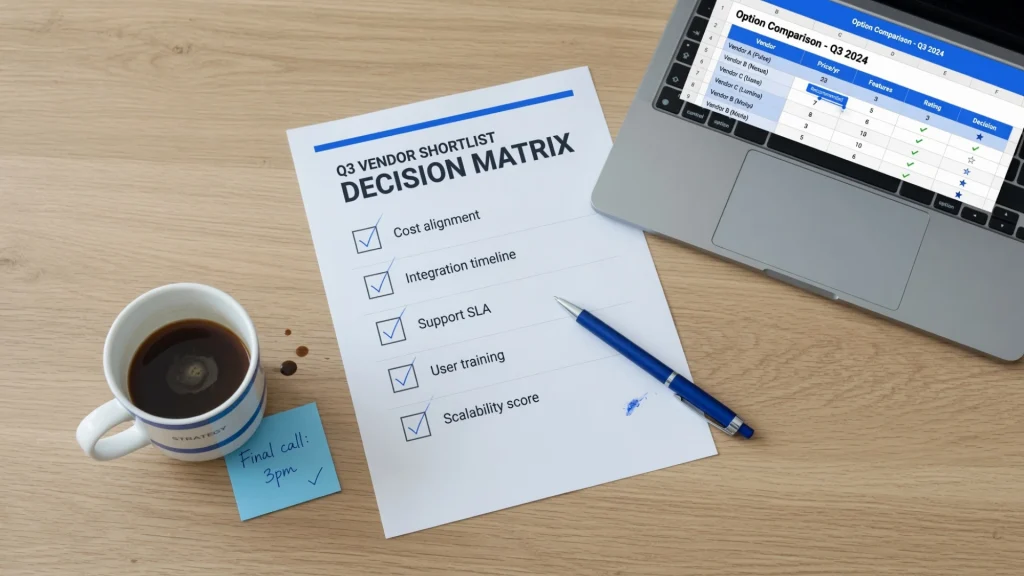
The 7-Point Vendor Scorecard (With Scoring Guide)
Use this scorecard to evaluate each vendor on a consistent scale. Score each criterion from 1 to 5, then total the score. A vendor scoring below 25/35 warrants serious scrutiny before proceeding.
Rate each criterion: 1 = Poor / 2 = Below Average / 3 = Average / 4 = Strong / 5 = Excellent
| # | Criterion | What to Evaluate | Weight | Score (1–5) |
|---|---|---|---|---|
| 1 | Tech Stack Alignment | Do they have production experience in your required stack? Can they staff the project without a long ramp-up? | High | __ |
| 2 | Portfolio Depth & Relevance | Have they built apps of similar complexity or industry? Do case studies include real metrics (not just screenshots)? | High | __ |
| 3 | Communication & Process | What project methodology do they follow? How are blockers, updates, and scope changes handled? Do you get a dedicated PM? | High | __ |
| 4 | Security & Compliance Posture | Do they follow secure-by-design principles? Can they meet your compliance needs (GDPR, HIPAA, SOC 2)? | High | __ |
| 5 | Post-Launch Support Model | Is there a defined SLA for bug fixes? What does the handover process look like? Do they offer maintenance retainers? | Medium | __ |
| 6 | Team Transparency | Will you meet the actual engineers? Is there clarity on who works on your project vs. who’s on the sales call? | Medium | __ |
| 7 | Commercial Clarity | Is pricing structured clearly (T&M, fixed price, milestone)? Are scope, ownership, and IP terms clearly defined in the contract? | High | __ |
Total Score: __ / 35
Scorecard Interpretation
| Total Score | Interpretation |
|---|---|
| 30–35 | Strong candidate. Proceed to reference checks and pilot milestone. |
| 25–29 | Acceptable with conditions. Clarify weak areas before signing. |
| 20–24 | High risk. Requires detailed justification for proceeding. |
| Below 20 | Walk away. Weak scores across multiple high-weight criteria signal future problems. |
Why Each Criterion Matters
Criterion 1 — Tech Stack Alignment is the first filter that eliminates 30–40% of vendors for any specialized project. A firm that hasn’t shipped in your specific stack isn’t a neutral option — they’re a liability. Demand specific project examples, not general capability claims.
Criterion 2 — Portfolio Depth goes beyond looking at screenshots. Strong vendors share case studies with before/after metrics: time to release, defect rates, performance benchmarks. If every story sounds identical and vague, you’re reading marketing copy (Right Tail, 2026).
Criterion 3 — Communication & Process is where most mid-project breakdowns originate. A vendor without a documented methodology — sprint planning, retrospectives, demo cycles — will default to ad-hoc updates. That creates scope creep. Research shows 78% of software projects experience scope creep, often leading to failure (Jobera, 2025).
Criterion 4 — Security has become non-negotiable. Data residency requirements, GDPR, HIPAA, and SOC 2 compliance now influence architecture decisions before a single line of code is written. Vendors who treat security as a final checklist item — not a design principle — expose you to serious regulatory and reputational risk.
Criterion 5 — Post-Launch Support is consistently underweighted during vendor selection. Applications don’t stop needing attention at go-live. Server costs, performance tuning, bug fixes, dependency updates, and feature iterations all require ongoing support. A vendor with no structured post-launch offering will leave you scrambling within months of launch.
Criterion 6 — Team Transparency addresses a common bait-and-switch: senior engineers close the deal, junior contractors deliver the project. Always request to meet the actual team — not just the account manager. Ask who owns your codebase day-to-day.
Criterion 7 — Commercial Clarity protects you legally and operationally. Pricing model (Time & Materials vs. fixed price), IP ownership clauses, milestone definitions, and change-order processes need to be in writing before work starts. Ambiguity here costs money later.
What Red Flags Should You Watch for During Vendor Evaluation?
Red flags in vendor evaluation often appear before the contract — in how a vendor communicates, what they avoid saying, and how they respond to hard questions. The following patterns consistently precede project failures and should trigger either disqualification or significant contract protections.
Here’s a practical red flags checklist to run through for every vendor on your shortlist:
🚩 Technical Red Flags
- No access to engineers during sales — You only speak with business development reps. Strong vendors let you talk to the actual team before signing.
- Resistance to using your tools — Unwillingness to work in your repo, cloud environment, or ticketing system without a legitimate technical reason.
- Overpromising AI — Every feature “solved with AI” without evaluation, governance, or specific implementation detail. (Right Tail, 2026)
- Vague tech stack claims — “We work with all technologies” is not an answer. Ask for specific frameworks, languages, and production deployment examples.
- No version control or CI/CD process — Vendors without automated testing and deployment pipelines create fragile, hard-to-maintain applications.
🚩 Commercial Red Flags
- Price-only positioning — No conversation about risk, scope, or maintenance. The lowest bidder in software development rarely delivers the lowest total cost.
- No milestone-based payment structure — Requiring full upfront payment or offering no milestone checkpoints removes your leverage and accountability mechanism.
- Unclear IP ownership clauses — If the contract doesn’t clearly assign source code ownership to you, you may not legally own what you paid for.
- No written Definition of Done — Strong teams say yes to this. Weak teams negotiate it away. (Right Tail, 2026)
🚩 Process and Communication Red Flags
- No defined project methodology — Agile, Scrum, Kanban — the specific framework matters less than having one. Vendors without a documented process default to chaos.
- Generic, identical proposals — If their proposal doesn’t reference your specific requirements, they didn’t read your brief. They sent a template.
- Slow response during evaluation — Communication patterns during sales predict communication during delivery. A vendor who takes four days to return your call won’t improve once you’ve paid.
- Negative-option security — “We can add security later” is a warning sign. Security retrofitted into an application costs three to six times more than security designed in from the start.
🚩 Portfolio Red Flags
- No verifiable client references — Case studies without named clients, LinkedIn verifiable contacts, or direct references should be treated as unverifiable marketing.
- Portfolio without metrics — Showing screenshots isn’t a portfolio. Real case studies include delivery timelines, performance improvements, and business outcomes.
Must Read: Custom software development outsourcing guide →
Vendors who resist writing a Definition of Done are typically protecting ambiguity — not their process. Ambiguity lets them renegotiate scope after work has started. Insisting on a written Definition of Done before signing is one of the highest-leverage contract protections available to buyers.
What Questions Should You Ask in the First Vendor Call?

The first call with a vendor is a qualification conversation, not a sales pitch. Your goal is to surface process clarity, team composition, past failure handling, and communication norms. These ten questions consistently reveal the most about whether a vendor can deliver.
Ask these questions and listen for specificity, honesty, and accountability — not polish.
Questions About Technical Capability
- “Can you walk me through a recent project with similar requirements to mine — and what challenges came up?” Strong vendors discuss problems and how they solved them. Weak vendors only describe successes.
- “Who specifically will work on my project day-to-day? Can I meet them before we sign?” This question surfaces bait-and-switch patterns immediately.
- “What’s your approach to code quality — do you have automated testing, code reviews, and CI/CD pipelines in place?” Expect specific answers (Jest, Cypress, GitHub Actions, etc.) — not general assurances.
Questions About Process and Communication
- “How do you handle scope changes mid-project? Walk me through your change-request process.” A vendor with a clear answer has managed scope professionally. Vague answers signal future disputes.
- “What project management tools do you use, and will I have visibility into progress in real time?” Look for Jira, Linear, Notion, or equivalent — and access for the client.
- “How often will we have scheduled checkpoints, and who attends from your team?” Weekly sprint reviews or bi-weekly demos are standard. Monthly “check-ins” are a red flag for a project of any meaningful complexity.
Questions About Security and Compliance
- “How do you handle data security — what’s your approach to authentication, encryption, and access controls?” Specific answers (OAuth 2.0, AES-256, role-based access control) indicate security maturity. General answers indicate it’s an afterthought.
- “Have you worked with compliance requirements like GDPR, HIPAA, or SOC 2? Can you share how you handled them on a past project?” Compliance experience isn’t transferable from goodwill — ask for specifics.
Questions About Post-Launch and Long-Term Partnership
- “What does your post-launch support model look like — is there an SLA for bug fixes, and how is that priced?” A vendor with no post-launch structure will disappear after delivery. Get the support model in writing.
- “If this project runs over timeline or budget, what’s the process? Who absorbs the overrun, and how is it escalated?” This question distinguishes accountable partners from liability-deflecting vendors. One in six IT projects with budgets over $15 million experience cost overruns of 200% (PMI, 2025). A plan for overruns should exist before overruns happen.
Must Read: Custom mobile app development cost guide →
How Do You Use the Scorecard in Practice?
Apply the scorecard after the first call — not before. The first call gives you the raw information. The scorecard structures your evaluation so you’re comparing vendors consistently, not on gut feel.
Here’s a practical workflow:
- Shortlist 3–5 vendors based on initial research, referrals, and portfolio fit.
- Conduct a structured first call using the 10 questions above. Take notes.
- Complete the scorecard independently for each vendor within 24 hours of the call.
- Share scores with your evaluation team (if applicable) before discussing opinions. Independent scoring prevents groupthink.
- Request a pilot milestone from your top-scoring vendor before committing to full engagement. A small, paid discovery sprint (2–4 weeks) reveals real delivery patterns faster than any reference check.
Over 85% of companies report their outsourcing partnerships meet or exceed expectations when a structured selection process is followed (Mismo Team, 2026). The difference between that outcome and the 25–50% failure rate isn’t luck — it’s process discipline at the evaluation stage.
[PERSONAL EXPERIENCE]: Projects that start with a paid discovery sprint (also called a scoping sprint or Phase 0) consistently surface vendor capability and communication patterns within the first two weeks — before any significant budget is committed. It’s the most reliable early-warning system available to buyers.
Must Read: MVP development services →
Frequently Asked Questions
How long does it typically take to evaluate a custom application development vendor?
A rigorous vendor evaluation — from initial research to signed contract — typically takes three to six weeks for mid-sized projects. This includes shortlisting (one week), structured calls and proposal review (two to three weeks), reference checks (one week), and contract negotiation (one to two weeks). Rushing this process is one of the top causes of poor vendor fit and project failure.
What’s the difference between a Time & Materials and a fixed-price contract for custom development?
Time & Materials (T&M) contracts bill based on actual hours worked, offering flexibility for evolving requirements but less cost predictability. Fixed-price contracts define scope and cost upfront, offering budget certainty but less flexibility for changes. Most custom application projects benefit from T&M with milestone-based payment gates — combining accountability with adaptability. Explore Software development Services
Should I choose a local or offshore custom application development vendor?
Both models work. The key is timezone overlap, communication frequency, and cultural alignment — not geography. Organizations increasingly adopt nearshoring and strategic partnerships to balance cost and collaboration quality (MarketsandMarkets, 2026). A well-run offshore team with daily standups outperforms a poorly managed local team every time.
How important is industry-specific experience when choosing a vendor?
Very important for regulated industries (healthcare, finance, legal) where compliance requirements directly shape architecture decisions. For general B2B or SaaS applications, portfolio relevance matters more than industry match. A vendor who built three fintech platforms understands data security, API integrations, and scalability challenges in ways that carry across industries.
What should a post-launch support contract include?
At minimum: bug fix response SLAs (critical bugs within 4 hours, non-critical within 48 hours), infrastructure monitoring responsibilities, dependency update cadence, and a defined escalation process. Ideally also include: a monthly maintenance retainer option, a knowledge transfer plan, and documented runbooks so your internal team can take over operations if needed.
What is a vendor scorecard and why should I use one?
A vendor scorecard is a structured evaluation tool that rates each candidate on consistent criteria using a numerical scale. It prevents selection decisions driven by proposal quality (which reflects marketing skill, not delivery capability) and creates a defensible, auditable record of your selection process — important for enterprise procurement, board reporting, or post-project reviews.
Conclusion
Choosing a custom application development vendor is one of the highest-stakes decisions in any software initiative. The market is crowded, proposals look polished, and the difference between a capable team and an expensive disappointment rarely surfaces until the project is already in trouble.
A structured evaluation process changes that.
Key Takeaways
- Define your evaluation criteria — tech stack, portfolio, communication, security, post-launch support — before you contact a single vendor.
- Use the 7-point scorecard consistently across every vendor. Scores below 25/35 are a serious warning.
- Red flags during evaluation (no engineer access, vague IP terms, no Definition of Done) predict problems during delivery.
- The first call is a qualification event — ask hard questions about failures, scope management, and security posture.
- Always propose a paid pilot milestone before full commitment. It’s the most reliable vendor signal available.
Final Recommendation
Don’t select a vendor based on price or proposal aesthetics. Select based on process clarity, team transparency, and demonstrated capability in your specific context. The evaluation investment you make upfront — structured, scored, and documented — directly determines the outcome of your project.
Ready to build with a partner that scores consistently? Explore how SSNTPL approaches custom application development — from discovery and architecture through post-launch support. Every project starts with a scoping conversation, not a sales pitch.
Sources: MarketsandMarkets (2026), Callibrity (2025), Right Tail (2026), Jobera (2025), PMI (2025), Mismo Team (2026), Precedence Research (2026)