How to Build a SaaS Product from Scratch: (2026 Guide)
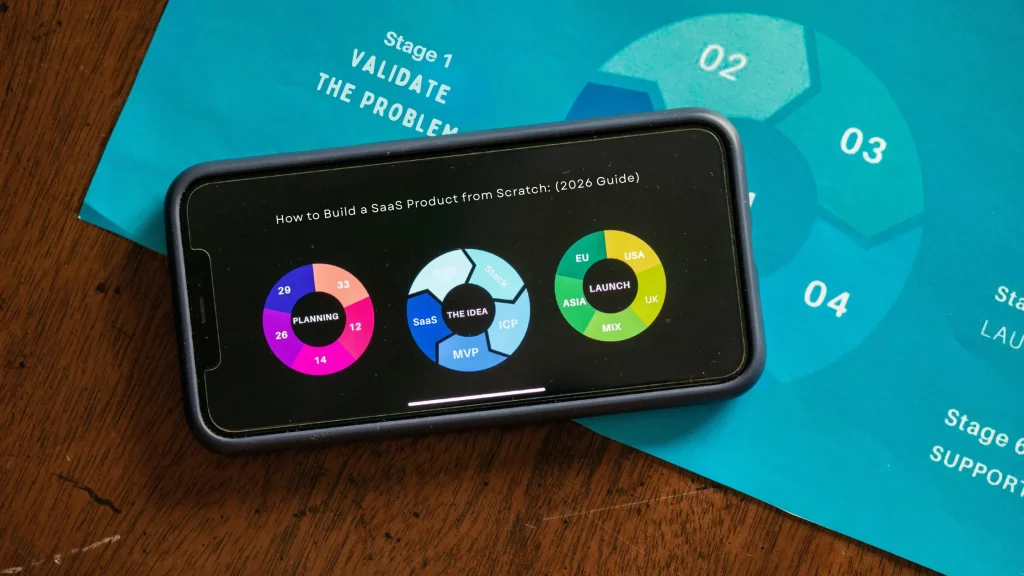
The SaaS market is projected to hit $375 billion in 2026 — and 90% of startups still fail. The ones that succeed validate before building, launch an MVP in 3-6 months, and charge before the product is perfect.
This guide covers the entire journey: from validating your idea to choosing your tech stack, building your MVP, pricing, launching, and scaling. Whether you’re a first-time founder or an experienced builder, this gives you a framework to avoid the common pitfalls.
TL;DR: The 7-Phase SaaS Build Journey
| Phase | Timeline | Cost Range | Key Deliverable |
|---|---|---|---|
| 1. Discovery & Planning | 2-4 weeks | $3K–$10K | Validated problem + ICP definition |
| 2. Tech Stack Selection | 1-2 weeks | — | Stack decision + starter kit choice |
| 3. Architecture & Design | 2-3 weeks | $5K–$15K | Multi-tenancy plan, auth/billing architecture |
| 4. MVP Development | 6-14 weeks | $15K–$75K | Working product with core features |
| 5. Testing & Security | 2-4 weeks | $3K–$15K | QA pass, security audit, compliance check |
| 6. Launch & GTM | 2-4 weeks | $5K–$20K | Landing page, onboarding flow, first customers |
| 7. Post-Launch Iteration | Ongoing | $2K–$10K/mo | Feedback loops, scaling, retention |
Before You Build: Validate Your SaaS Idea
Most SaaS founders start with a solution. Winners start with a problem. Validating your idea before writing code is the single highest-ROI activity in the entire process.
5 Validation Methods That Work
1. Problem interviews — Talk to 20-30 people in your target market. Ask about their current workflow, what frustrates them, and what they’ve tried. Don’t mention your solution until the last 5 minutes.
2. Landing page test — Build a one-page site describing the product with a “Buy Now” button at a real price. Drive 200-500 targeted visitors. If 5%+ click the button, you have something.
3. Concierge MVP — Deliver the service manually. Use spreadsheets, email, and phone calls to simulate what the software would do. If people pay for the manual version, they’ll pay for the automated one.
4. Wizard of Oz MVP — Build a simple front-end that looks like a working product, but handle the backend manually. Zappos started by buying shoes from stores and shipping them themselves.
5. Pre-sell — Ask 10+ people to give you a credit card for early access before any code is written. Money talks. Interest doesn’t.
Ready-to-Build Checklist
- 20+ problem interviews completed
- 5+ people said “I’d pay for this”
- You can name your ICP in one sentence
- Existing solutions are expensive or clunky
- You have 2-3 years runway or commitment
- You know how to reach your first 100 customers
Phase 1: Discovery & Planning (2-4 weeks | $3K–$10K)
Define Your ICP
“Small businesses” is not an ICP. “Bootstrapped B2B SaaS founders with $10K-$100K ARR managing their own email marketing” is.
Answer these five questions:
- Who are they? (job title, company size, industry)
- What does their day look like? (workflows, tools they use)
- What is the exact pain? (what breaks, how often, what it costs)
- Who controls the budget? (buyer vs user)
- What does success look like? (the outcome your product must deliver)
The One ICP Rule: Pick one ICP for your first 100 customers. Build specifically for them. Expand only after you have 100 paying customers from that segment.
Scope Your MVP
Your MVP should solve one problem for one ICP better than any existing alternative.
Feature prioritization framework:
| Priority | Definition | Action |
|---|---|---|
| Must Have | Without this, the product can’t solve the core problem | Goes in MVP |
| Should Have | Improves experience significantly but product works without it | Version 1.1 |
| Nice to Have | Valuable but users won’t notice its absence in Month 1 | Backlog |
| Delete | Features because competitors have them, not because your ICP asked | Don’t build |
What an actual MVP includes:
- Core feature — the single workflow solving the validated problem
- Authentication — use Auth0 or Clerk, never build this yourself
- Billing — Stripe integration (if people can’t pay you, you don’t have a business)
- Basic onboarding — path from signup to value in under 10 minutes
For a complete budget breakdown by phase, see our SaaS development cost guide.
Phase 2: Tech Stack Selection — The 2026 Comparison
Your tech stack affects development speed, hiring flexibility, infrastructure costs, and long-term maintainability. Here’s how the most popular stacks compare.
| Criteria | Next.js + Supabase | Next.js + Prisma + Postgres | Laravel + Vue | Django + React | Rails + Hotwire |
|---|---|---|---|---|---|
| MVP cost (build) | $15K–$35K | $20K–$40K | $15K–$35K | $20K–$45K | $20K–$40K |
| Monthly infra (MVP) | $50–$200 | $100–$300 | $50–$200 | $100–$300 | $100–$300 |
| Scalability | High | High | Medium | High | Medium |
| Hiring pool | Very large | Very large | Large | Large | Medium |
| Best for | Rapid MVPs, full-stack JS | Data-heavy apps | Rapid MVPs, PHP ecosystem | AI/ML apps, data products | Convention-over-configuration |
| Auth built-in? | Yes (Supabase Auth) | No (add Clerk/Auth0) | No (add Laravel Jetstream) | No (add django-allauth) | No (add Devise) |
Starter Kit Options
Instead of building from scratch, consider a SaaS starter kit. These give you auth, billing, and basic UI out of the box:
| Starter Kit | Price | Stack | Best For |
|---|---|---|---|
| ShipFast | $189 | Next.js + MongoDB | Solo founders, rapid prototyping |
| SaaS Pegasus | $349 | Django + React/Next.js | Python developers |
| Gravity | $499 | Next.js + Tailwind + Stripe | Full-stack JS founders |
| Divjoy | $149 | React + various backends | Design-focused founders |
| Custom build | $15K–$35K | Your choice | Complex requirements, compliance needs |
Our recommendation: Start with ShipFast or Gravity if you’re a technical founder. Use a starter kit, validate fast, and graduate to custom development when you need multi-tenancy, compliance, or complex integrations.
Phase 3: Architecture & Database Design (2-3 weeks | $5K–$15K)
Multi-Tenancy: Choose Your Data Isolation Model
This decision must be made before writing code — changing it later is painful.
| Model | Isolation Level | Cost | Complexity | Best For |
|---|---|---|---|---|
| Shared DB, Shared Schema | Low | Lowest | Lowest | MVPs, early-stage |
| Shared DB, Separate Schema | Medium | Low | Medium | Mid-stage, basic data isolation |
| Separate Database | High | High | High | Enterprise, compliance-heavy |
Our recommendation: Start with shared DB + row-level isolation. It’s the cheapest and simplest. Graduate to separate databases only when compliance or scale demands it.
Auth + Billing: Don’t Build These From Scratch
| Service | What It Does | Pricing | Why Use It |
|---|---|---|---|
| Clerk | Auth, user management | Free tier, then $25/mo | Best developer experience, built for Next.js |
| Auth0 | Enterprise auth | Free tier, then $23/mo | Most features, SOC 2 compliant |
| Stripe | Payment processing | 2.9% + 30¢ per transaction | Industry standard, best docs |
| Paddle | Payment processing + tax/VAT | 5% + 50¢ | Handles global tax compliance |
| LemonSqueezy | Payment processing | 5% + 50¢ | Simple, founder-friendly |
Never build auth or billing from scratch. You’ll waste 4-8 weeks reinventing wheels that battle-tested services already solve.
Phase 4: MVP Development — Core Features Only (6-14 weeks | $15K–$75K)
The 4-Tier MVP Cost Framework
| Tier | What You Get | Timeline | Cost Range |
|---|---|---|---|
| Prototype | No auth, no billing, basic UI, single-user | 3-4 weeks | $8K–$15K |
| Single-User MVP | Auth, billing, core feature, single user | 6-10 weeks | $15K–$35K |
| Multi-Tenant SaaS | Full auth, billing, team features, dashboards | 3-5 months | $40K–$90K |
| Enterprise-Ready | Compliance, SSO, audit logs, dedicated infra | 6-18 months | $100K–$500K+ |
Most founders should target Tier 2 (Single-User MVP) . Launch with paying customers, then reinvest revenue into multi-tenant features.
Build vs Hire vs No-Code
| Approach | Cost Range | Timeline | Best For |
|---|---|---|---|
| Build it yourself | $0 + time | 3-6 months | Technical co-founders |
| No-code (Bubble/Webflow) | $1K–$8K | 4-8 weeks | Non-technical founders validating fast |
| Freelancer | $15K–$50K | 2-4 months | Simple, well-defined MVP |
| Offshore agency | $25K–$75K | 3-5 months | Broader scope, cost-efficient |
| US/Western agency | $75K–$200K | 3-6 months | Complex requirements, compliance |
The smartest path: Validate with no-code or a prototype. Once you have paying customers and clear feature requests, invest in a custom build with an experienced partner. Don’t build the perfect product before anyone pays.
If you’re considering a development partner, our custom SaaS development services page explains how we structure engagements for early and growth-stage SaaS products.
Phase 5: Testing, Security & Compliance (2-4 weeks | $3K–$15K)
| Area | What to Test | Tools |
|---|---|---|
| Unit tests | Individual functions and components | Jest, Vitest, pytest |
| Integration tests | API endpoints, database queries | Supertest, Playwright |
| E2E tests | Full user flows | Cypress, Playwright |
| Load tests | Performance under traffic | k6, Artillery |
| Security | Vulnerabilities, OWASP top 10 | OWASP ZAP, Snyk |
| Compliance | GDPR, CCPA, HIPAA (if applicable) | Varies by regulation |
Don’t skip this phase. A security breach in Year 1 can kill a SaaS startup. Invest in testing before launch, not after.
Phase 6: Launch & Go-to-Market (2-4 weeks | $5K–$20K)
Launch Checklist
- Landing page with clear value proposition
- Documentation / knowledge base
- Onboarding flow (signup → first value in under 10 minutes)
- Pricing page (3 tiers minimum)
- Analytics (Mixpanel, Amplitude, or PostHog)
- Support channel (Crisp, Intercom, or email)
- Status page (for transparency)
Getting Your First 100 Customers
1. Direct outreach — Email or LinkedIn message 100 people in your ICP. Slow but highest conversion.
2. Launch platforms — Product Hunt, Hacker News, BetaList. Good for B2C and developer tools.
3. Community-led growth — Be genuinely helpful in Slack groups, Reddit, Discord. Share insights. Mention product only when relevant.
4. Content marketing — Write content targeting searches your ICP makes. 57% of SaaS companies prioritize this — it drives 400% more leads than outbound.
5. Paid acquisition — Only after you have a converting landing page. Don’t validate with ads.
Phase 7: Post-Launch — Iterate, Scale, Retain (Ongoing | $2K–$10K/mo)
The SaaS Metrics That Matter
| Metric | Healthy Benchmark | Red Flag |
|---|---|---|
| MRR growth | 10-20% month over month | Flat or declining |
| Monthly churn | Under 3% (B2B SaaS avg: 3.5%) | Above 5% |
| Net Revenue Retention | Above 102% | Below 100% |
| CAC payback period | Under 12 months | Over 18 months |
| LTV:CAC ratio | 3:1 or higher | Below 2:1 |
| Activation rate | 40%+ of signups reach value | Below 20% |
Product-Market Fit Test
Survey active users: “How would you feel if you could no longer use this product?”
If 40%+ say “very disappointed” — you have product-market fit. Below 40%? Don’t add marketing spend. Have deeper customer conversations to find what’s missing.
How Much Does It Cost to Build a SaaS in 2026?
3 Budget Tiers
| Tier | Build Cost | Year 1 Ops | Total Year 1 | Best For |
|---|---|---|---|---|
| Lean MVP (Offshore) | $30K–$60K | $15K–$25K | $45K–$85K | Bootstrapped, validating |
| Production-Ready (Agency) | $60K–$120K | $25K–$50K | $85K–$170K | Funded, launched |
| Full-Scale (Senior Team) | $150K–$350K | $50K–$100K | $200K–$450K | Enterprise, scaling fast |
Monthly Tool Stack Costs (MVP Stage)
| Category | Tool | Monthly Cost |
|---|---|---|
| Auth | Clerk or Auth0 | $23–$240 |
| SendGrid or Loops | $20–$200 | |
| Payments | Stripe | 2.9% + 30¢ per transaction |
| Monitoring | Sentry + PostHog | $26–$300 |
| Support | Crisp or Intercom | $74–$500 |
| Analytics | Mixpanel or Amplitude | $25–$995 |
| Hosting | Vercel or Railway | $20–$200 |
| Total | ~$200–$2,500/mo |
For a deeper cost breakdown by stage and region, see our SaaS development cost guide and SaaS MVP cost guide.
Build vs Buy vs No-Code: Decision Framework
| Factor | Build Custom | No-Code/Low-Code | Buy/Integrate |
|---|---|---|---|
| Cost | $25K–$500K+ | $1K–$15K/yr | $50–$5K/mo |
| Timeline | 3-12 months | 2-8 weeks | Days to weeks |
| Control | Full | Platform-dependent | Vendor-dependent |
| Customization | Unlimited | Limited to platform | Config only |
| Scalability | High | Medium | Vendor-dependent |
| Competitive advantage | High | Low | None (same tool as competitors) |
| Best when | You have unique workflows, need IP ownership | You’re validating fast, have simple requirements | The tool solves the problem well enough |
When to graduate from no-code to custom:
- Your no-code platform is hitting performance limits
- You need custom integrations that the platform doesn’t support
- You’re raising funding and need proprietary technology
- Your user base is growing beyond what no-code can handle
Common SaaS Build Mistakes (And How to Avoid Them)
1. Building Auth and Billing From Scratch
Fix: Use Clerk + Stripe. This saves 4-8 weeks of development.
2. Scope Creep
Fix: Use the MoSCoW framework. Lock MVP features before development starts. Everything else goes to the backlog.
3. Ignoring Multi-Tenancy Until Later
Fix: Decide your data isolation model in Phase 3. Retrofitting multi-tenancy is expensive and risky.
4. Underestimating Infrastructure Costs
Fix: Budget $500–$1,500/month from Day 1 for infrastructure, tools, and monitoring.
5. No Distribution Plan
Fix: Before writing code, know exactly how you’ll reach your first 100 customers. Build in public, create content, start conversations.
6. Building for 12 Months Before Launching
Fix: Ship an ugly MVP in 3-4 months. Iterate based on real feedback. Perfect is the enemy of shipped.
7. Pricing Too Low
Fix: Price at 10-20% of the value you deliver. Customers paying $9/month aren’t the ones who’ll take you to $1M ARR.
When to Hire a SaaS Development Company
You don’t need a development partner at every stage. But if these apply, it’s time:
- ✅ You’ve raised funding or have budget over $50K
- ✅ Your project is more complex than a single-user MVP
- ✅ You need multi-tenancy, compliance, or complex integrations
- ✅ You’re on a timeline (need to launch in 3-6 months)
- ✅ You don’t have a technical co-founder
If you’re in this position, consider hiring dedicated SaaS developers who can take your product from architecture to launch while you focus on customers, funding, and growth.
For a detailed comparison of hiring models, see our guide on how to hire SaaS developers — covering rates, red flags, and engagement models.
Frequently Asked Questions
How long does it take to build a SaaS product?
A well-scoped MVP takes 3-6 months. No-code MVPs can ship in 4-8 weeks. Enterprise platforms with compliance requirements take 6-18 months.
How much does SaaS development cost in 2026?
A no-code MVP costs $1K–$8K. A custom MVP costs $15K–$75K. Full-scale enterprise builds range from $150K–$500K+. First-year total including operations: $45K–$450K depending on scope.
What is a SaaS MVP?
A SaaS MVP (Minimum Viable Product) is the smallest version of your product that solves the core problem for paying customers. It includes authentication, billing, one core feature, and basic onboarding — nothing else.
What is the best tech stack for a SaaS in 2026?
Next.js + Supabase is the most popular choice for speed and scalability. Django + React is best for AI/ML products. Laravel + Vue works well for rapid development. Choose based on your team’s expertise and product requirements.
Should I use a SaaS starter kit?
Yes — starter kits like ShipFast ($189), SaaS Pegasus ($349), and Gravity ($499) give you auth, billing, and basic UI out of the box. They save 4-8 weeks of setup time compared to building from scratch.
How do I validate my SaaS idea before building?
Use the 5 methods: problem interviews (20-30 people), landing page test (5%+ click rate), concierge MVP (manual delivery), Wizard of Oz (fake automation), and pre-sell (credit cards before code).
What’s the difference between no-code and custom SaaS?
No-code (Bubble, Webflow) is faster and cheaper but limited in customization and scalability. Custom development gives you full control, unlimited customization, and better scalability — at a higher upfront cost.
When should I hire a SaaS development company?
When you have budget over $50K, need multi-tenancy or compliance, are on a timeline, or don’t have a technical co-founder. Hire after validation — not before.
Ready to Build Your SaaS Product?
Whether you’re validating an idea or scaling an existing product, the right development partner makes the difference between shipping in months and shipping in weeks.
We’ve built SaaS products for startups and enterprises across fintech, healthcare, logistics, and B2B — from MVP to multi-tenant platforms serving thousands of users.
Tell us about your product. We’ll give you a scope, timeline, and estimate within 48 hours.
📥 Download Free Resource: SaaS MVP Budget Planner (PDF) — Plan your build costs, monthly operations, and first-year total before you start.
Related articles
How to Evaluate a Custom Application Development Vendor: 7-Point Scorecard
Choosing the wrong custom application development vendor costs more than money. Use this 7-point scorecard — with scoring guide, red flags checklist, and first-call questions — to choose the right partner in 2026.

Custom Software Development Cost 2026: Hourly Rates by Region, Type & Budget Guide
Custom software costs $15K-$500K+ depending on complexity and region. US rates: $100-$250/hr. India: $20-$70/hr. Full breakdown by project type.
What Is Application Software? Definition, 12 Types & Examples (2026)
Application software is a program built for end-user tasks — think Word, Chrome, WhatsApp. Clear definition, 12 types with real examples, and how it differs from system software.
Let's build together
Let's build something that moves your business forward.
Tell us about your project and get a free, no-obligation estimate from our engineering team — typically within one business day.