Mobile App Development Explained: The Ultimate Guide
The mobile app economy is no longer just a digital trend; it is a multi-trillion dollar powerhouse. With global app revenue projected to hit nearly $800 billion by 2029, the question for businesses is no longer if they should build an app, but how they can build one that stands out in a crowded marketplace.
At SSNTPL, we believe an app shouldn’t just exist—it should excel. This guide breaks down the complex journey of mobile app development into a transparent, actionable roadmap for entrepreneurs and enterprises alike.
1. Why Your Business Needs a Mobile-First Strategy
A mobile app is the most direct link you have to your customer. Beyond simple accessibility, it offers:
- Hyper-Personalization: Utilizing AI to tailor experiences based on user behavior.
- Direct Marketing Channels: Instant communication through push notifications.
- Data-Driven Insights: Gathering real-time analytics to refine your business model.
- Increased Retention: Creating a “sticky” ecosystem that keeps users coming back.
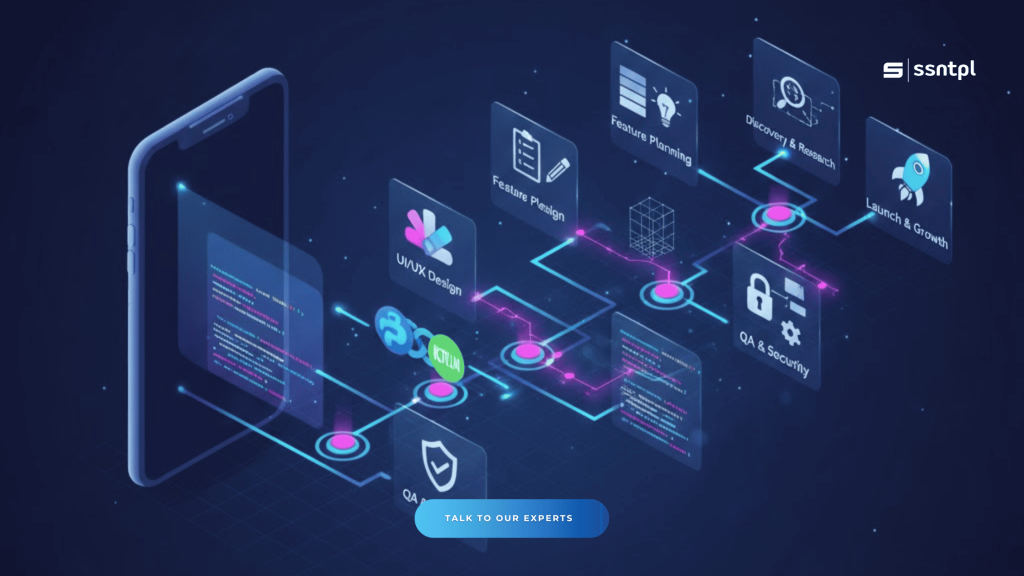
2. The Roadmap: 7 Steps to a Successful Launch
The difference between a viral success and an “uninstalled” app lies in the process. We follow a disciplined, 7-step lifecycle:
Step 1: Discovery & Market Research
Don’t build in a vacuum. You must identify the “Micro-Problem” your app solves. Conduct a gap analysis of your competitors: What do their users complain about in 2-star reviews? That is your opportunity.
Step 2: Strategic Feature Finalization
Resist “feature creep.” For a first launch, focus on the core functionality. If you’re building an e-commerce app, your “Search,” “Cart,” and “Payment” must be flawless before you worry about AR virtual try-ons.
Step 3: UI/UX Design (The Visual Blueprint)
We don’t just design screens; we design experiences. This includes:
- Wireframing: The skeletal framework of your app.
- The “Thumb Zone” Rule: Placing critical buttons where they are easily reachable.
- Micro-interactions: Subtle animations that make the app feel alive.
Step 4: Selecting the Tech Stack
Choose the foundation that fits your budget and performance needs:
- Native (Swift/Kotlin): Best for high-performance, hardware-heavy apps.
- Cross-Platform (Flutter/React Native): The most cost-effective way to launch on both iOS and Android simultaneously with one codebase.
Step 5: The Build (Frontend & Backend)
The Frontend is what users touch; the Backend is the “brain” on the server. At SSNTPL, we use Agile methodology, delivering functional “Sprints” so you see progress in real-time.
Step 6: Rigorous QA & Testing
A single bug can kill your reputation. Our testing covers:
- Functional Testing: Does every button work?
- Security Testing (VAPT): Is user data encrypted and safe from hackers?
- Device Fragmentation: Does it work on an iPhone 16 and a five-year-old Android?
Step 7: Launch & Post-Launch Growth
Launching is the beginning. You need App Store Optimization (ASO) to be found and a feedback loop to iterate based on real user data.
3. Avoiding the “App Death” Pitfalls
Most apps fail due to these three common mistakes:
- Poor UI/UX: Users are impatient. If the navigation is confusing, they will delete the app in seconds.
- Lack of Monetization Strategy: Whether it’s subscriptions, in-app purchases, or ads, your revenue model must be baked into the architecture.
- Ignoring Security: In 2025, data privacy is non-negotiable. Compliance with global standards isn’t optional; it’s a prerequisite.
4. Understanding the Cost of Quality
Mobile app development is an investment. Costs typically vary based on:
- Complexity: A simple informational app ($30k+) vs. a complex enterprise solution ($150k+).
- Platform: Developing for one OS is cheaper, but cross-platform offers the best ROI for reaching a wider audience.
- Maintenance: Expect to spend 15–20% of the initial cost annually on updates and server management.
Final Thoughts: Your Idea, Our Masterpiece
Building a mobile app is a complex undertaking, but with the right partner, it is the most transformative step your business can take. At SSNTPL (Sword Software N Technologies Pvt. Ltd.), we bring a decade of international expertise and a commitment to integrity to every project. We don’t just deliver code; we deliver digital assets that drive growth.
Related articles

How to Evaluate a Custom Application Development Vendor: 7-Point Scorecard
Choosing the wrong custom application development vendor costs more than money. Use this 7-point scorecard — with scoring guide, red flags checklist, and first-call questions — to choose the right partner in 2026.

Custom Software Development Cost 2026: Hourly Rates by Region, Type & Budget Guide
Custom software costs $15K-$500K+ depending on complexity and region. US rates: $100-$250/hr. India: $20-$70/hr. Full breakdown by project type.
What Is Application Software? Definition, 12 Types & Examples (2026)
Application software is a program built for end-user tasks — think Word, Chrome, WhatsApp. Clear definition, 12 types with real examples, and how it differs from system software.
Let's build together
Let's build something that moves your business forward.
Tell us about your project and get a free, no-obligation estimate from our engineering team — typically within one business day.