

Choosing between offshore, nearshore, and onshore software development is one of the most consequential decisions for enterprise technology leaders. Each model offers distinct advantages in cost, talent access, time zone overlap, and cultural alignment. This framework helps you evaluate which model fits your project requirements, risk tolerance, and strategic priorities.
The Three Development Models Defined
Onshore Development
Definition: Development team located in the same country as your business.
Typical Locations: US companies hire US developers. UK companies hire UK developers.
Key Characteristics:
- Highest cost (US rates: $125–$250+/hour)
- Same time zone, maximum real-time collaboration
- Cultural and language alignment
- Easier in-person meetings
- Highest talent competition (top US developers are expensive and in demand)
Best For:
- Highly sensitive projects requiring maximum oversight
- Projects requiring frequent in-person collaboration
- Companies with unlimited budget and need for domestic talent
Nearshore Development
Definition: Development team located in a nearby country or region with similar time zones.
Typical Locations: US companies hire from Canada, Mexico, Argentina, Colombia, Brazil. UK companies hire from Eastern Europe (Poland, Ukraine, Romania).
Key Characteristics:
- Moderate cost (typically 30–50% less than onshore)
- 1–4 hour time zone difference (daily overlap possible)
- Similar cultural business practices
- Good English proficiency
- Shorter travel distances for in-person meetings
Best For:
- Projects requiring regular real-time collaboration
- Companies prioritizing time zone overlap
- Teams that value cultural and language proximity
Offshore Development
Definition: Development team located in a distant country with significant time zone difference.
Typical Locations: US companies hire from India, Ukraine, Vietnam, Philippines. UK companies hire from India, Vietnam, Philippines.
Key Characteristics:
- Lowest cost (typically 60–80% less than onshore)
- 8–12 hour time zone difference (requires structured communication)
- Access to large talent pools (India: 5M+ developers)
- 24-hour development cycles possible (follow-the-sun model)
- Requires mature communication processes and documentation
Best For:
- Cost-conscious projects with well-defined requirements
- Long-term partnerships with dedicated development team
- Companies with experience managing remote teams
- Projects where async communication is acceptable
Comparative Analysis
| Factor | Onshore | Nearshore | Offshore |
|---|---|---|---|
| Hourly Rate | $125–$250+ | $75–$125 | $25–$75 |
| Time Zone Overlap | 100% | 60–80% | 30–50% |
| Talent Pool Size | Limited | Moderate | Large |
| Cultural Alignment | High | High | Moderate |
| Language Proficiency | Native | Excellent | Good–Excellent |
| Travel Convenience | Easy | Moderate | Difficult |
| Cost Savings | None | 30–50% | 60–80% |
Curious to know about evaluating a software partner?
When to Choose Each Model
Choose Onshore When…
- You have unlimited budget and prioritize domestic talent
- Your project requires daily in-person collaboration
- Security or compliance requirements mandate onshore development
- You’re building highly sensitive IP (defense, government)
- Your team has no experience managing remote developers
Choose Nearshore When…
- You need regular real-time collaboration (daily standups, sprint planning)
- You value cultural and language proximity
- You want moderate cost savings without major time zone challenges
- Your project has evolving requirements requiring frequent communication
- You want the option for periodic in-person meetings without long flights
Choose Offshore When…
- You want maximum cost efficiency (60–80% savings)
- Your project has well-defined requirements and stable scope
- You’re comfortable with async communication and structured handoffs
- You want access to large talent pools (scale quickly)
- You’re building a long-term partnership with a dedicated team
- You have experience managing remote or distributed teams
If you decide an offshore model fits your budget and timeline, our offshore custom software development practice delivers senior engineering with full-time-zone overlap and dedicated project management.
Mitigating Offshore Risks
Offshore development offers the highest cost savings but requires intentional risk management:
Communication & Collaboration
Challenge: Time zone differences limit real-time interaction.
Solutions:
- Define clear communication windows (e.g., 2–3 hours of daily overlap)
- Use async communication tools (Slack, Jira, Confluence)
- Document decisions in writing (not just verbal)
- Schedule structured handoffs between time zones
Quality & Security
Challenge: Distance makes oversight difficult.
Solutions:
- Choose ISO 27001 certified vendors
- Implement automated testing and CI/CD pipelines
- Conduct regular code reviews and security audits
- Define clear acceptance criteria and quality gates
- Require comprehensive documentation
Cultural & Language Alignment
Challenge: Different work cultures and communication styles.
Solutions:
- Choose vendors with experience in your market (US, UK, EU)
- Invest in relationship building (virtual team events)
- Define communication protocols and escalation paths
- Ensure English proficiency for key team members
IP Protection & Legal
Challenge: Different legal jurisdictions and enforcement.
Solutions:
- Sign comprehensive NDAs and MSAs before sharing IP
- Use source code escrow
- Ensure clear IP ownership transfer in contracts
- Choose vendors with strong legal frameworks (India has robust IP laws)
The Hybrid Model: Best of Both Worlds
Many enterprises use a hybrid approach:
- Onshore: Product managers, architects, client-facing roles
- Nearshore/Offshore: Development, QA, DevOps, support
This model balances cost, collaboration, and control.
SSNTPL’s Offshore Approach
SSNTPL is headquartered in Delhi, India, with a delivery model designed for global enterprise clients:
Time Zone Optimization
- Daily overlap: 8+ hours with US East Coast, 4+ hours with US West Coast
- Communication windows: Structured daily standups during overlap hours
- Async collaboration: Comprehensive documentation and handoff processes
Enterprise-Grade Security
- ISO 27001 certified information security management
- GDPR, HIPAA readiness for regulated industries
- Secure development environments and access controls
- Full IP protection and source code escrow options
Process Maturity
- 15+ years of offshore delivery experience
- Proven development process with Agile methodologies
- Dedicated project managers as single point of contact
- Regular sprint reviews and client feedback loops
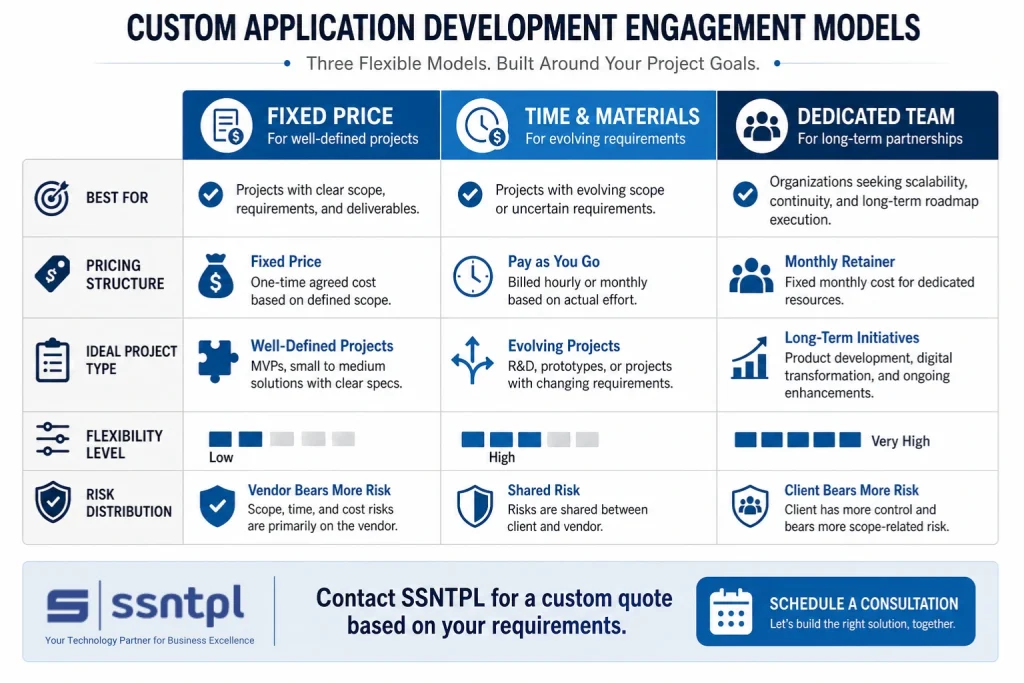
Engagement Flexibility
- Fixed Price for well-defined projects
- Time & Materials for evolving requirements
- Dedicated Team for long-term partnerships
Decision Framework: Which Model for Your Project?
Answer these questions to determine the best fit:
| Question | If Yes → | If No → |
|---|---|---|
| Is budget the primary constraint? | Offshore | Evaluate cost vs. other factors |
| Do you need daily real-time collaboration? | Onshore or Nearshore | Offshore is viable |
| Is this a short-term, fixed-scope project? | Offshore | Evaluate based on other factors |
| Is this a long-term, evolving product? | Nearshore or Offshore with Dedicated Team | Onshore if budget allows |
| Do you have experience managing remote teams? | Offshore or Nearshore | Nearshore or Onshore |
| Is security/compliance extremely high? | Onshore or Nearshore with strong vendor | Offshore with ISO 27001 certified vendor |
| Do you need access to specialized skills? | Offshore (largest talent pool) | Evaluate based on skill availability |
Getting Started
The right development model depends on your specific project requirements, constraints, and risk tolerance.
SSNTPL offers a free consultation to help you:
- Assess which engagement model fits your project
- Evaluate our offshore delivery capabilities
- Discuss your security, compliance, and communication requirements
- Review relevant case studies and client references
Ready to hire offshore software development partner
Schedule Your Free Consultation →