GPT-5.5 Review: Benchmarks, Pricing, Codex, and Is It Worth It? (2026)
TL;DR: GPT-5.5 Quick Summary
What is GPT-5.5? OpenAI’s latest frontier AI model (released April 23, 2026), designed for agentic workflows—autonomous multi-step tasks in coding, computer use, and research.
Pricing:
- API: $5/$30 per million input/output tokens (2x GPT-5.4’s $2.50/$15)
- ChatGPT: Included in Plus ($20/mo), Pro ($200/mo), Business/Enterprise
- Not available: Free tier (no timeline announced)
GPT-5.5 vs Claude Opus 4.7:
- GPT-5.5 wins: Agentic coding, terminal tasks, computer use, FrontierMath
- Claude wins: Real-world GitHub issue resolution (SWE-Bench Pro: 64.3% vs 58.6%)
Bottom line: Use GPT-5.5 for autonomous, multi-step coding workflows. Use Claude Opus 4.7 for code review and repository-level reasoning. GPT-5.5 costs 20% more per token but saves 25-40% on task retries.
Available now: ChatGPT Plus/Pro/Business/Enterprise
Coming soon: API access, Cursor integration, GitHub Copilot (Business/Enterprise)
Building with Claude/GPT? SSNTPL builds custom AI integrations, agentic workflows, and enterprise AI solutions. Talk to our team →
What Is GPT-5.5?
GPT-5.5 is OpenAI’s latest frontier AI model, released April 23, 2026—their smartest and most capable model to date. It’s not a chatbot upgrade. It’s an agentic work model designed to understand complex goals, use tools, verify its work, and complete multi-part tasks autonomously without constant human supervision.
GPT-5.5 arrives just seven weeks after GPT-5.4 (March 5, 2026), which itself launched only two days after GPT-5.3. This aggressive release cadence signals OpenAI’s focus on rapid iteration in the agentic AI era.
What Makes GPT-5.5 Different?
Traditional AI models (like GPT-4, early GPT-5 versions) excel at answering questions or generating content but struggle with multi-step workflows requiring tool use, verification, and iteration.
Agentic AI models (like GPT-5.5) can:
- Break complex tasks into subtasks
- Use tools autonomously (browsers, terminals, code editors)
- Check their own work and iterate
- Complete workflows from start to finish with minimal human intervention
Key improvements in GPT-5.5:
- Agentic coding: Writes, debugs, and tests code across multiple files
- Computer use: Controls browsers, clicks buttons, fills forms, captures screenshots
- Extended context: 1M tokens (vs 400K in GPT-5.4 API)—processes entire codebases or long documents
- Token efficiency: Uses ~40% fewer output tokens for the same task
The Three GPT-5.5 Variants Explained
GPT-5.5 ships in three forms, each optimized for different use cases:
1. GPT-5.5 (Standard)
What it is: The default model in ChatGPT and Codex for paid subscribers
Best for: General agentic tasks, coding, document analysis, multi-step workflows
API model string: gpt-5.5
Available to: ChatGPT Plus, Pro, Business, Enterprise
2. GPT-5.5 Thinking
What it is: Optimized for faster responses on complex problems with more concise outputs
Best for: Technical debugging, research questions requiring deep reasoning
How to use: Select “GPT-5.5 Thinking” in ChatGPT model picker
Available to: ChatGPT Plus and above
3. GPT-5.5 Pro
What it is: Same underlying model with extra parallel test-time compute for harder problems
Best for: Advanced math, scientific research, deep retrieval tasks
API model string: gpt-5.5-pro
Available to: ChatGPT Pro ($200/mo), Business, Enterprise
Not available: Plus tier
Technical note: GPT-5.5 Pro is not a separate training run. It deploys additional parallel inference compute to tackle exceptionally difficult problems that benefit from extended reasoning.
GPT-5.5 Benchmarks: How It Performs vs Competitors
OpenAI released comprehensive benchmark results comparing GPT-5.5 to Claude Opus 4.7 and Gemini 3.1 Pro across six key evaluations:
| Benchmark | GPT-5.5 | Claude Opus 4.7 | Gemini 3.1 Pro | What It Measures |
|---|---|---|---|---|
| Terminal-Bench 2.0 | 82.7% ⭐ | 69.4% | 68.5% | Terminal/CLI task completion |
| SWE-Bench Pro | 58.6% | 64.3% ⭐ | — | Real-world GitHub issue resolution |
| Expert-SWE (20hr) | 73.1% ⭐ | — | — | Long-horizon coding tasks |
| GDPval | 84.9% ⭐ | 80.3% | 67.3% | General coding proficiency |
| OSWorld-Verified | 78.7% ⭐ | 78.0% | — | Computer use / GUI interaction |
| FrontierMath Tier 4 | 35.4% ⭐ | 22.9% | 16.7% | Advanced mathematical reasoning |
Honest Read: Where Each Model Wins
GPT-5.5 dominates:
- ✅ Agentic coding (Terminal-Bench: 82.7% vs Claude’s 69.4%)
- ✅ Long-horizon tasks (Expert-SWE: 73.1%)
- ✅ Computer use (OSWorld: 78.7% vs Claude’s 78.0%)
- ✅ Advanced math (FrontierMath: 35.4% vs Claude’s 22.9%)
Claude Opus 4.7 leads:
- ✅ Real-world GitHub issue resolution (SWE-Bench Pro: 64.3% vs GPT’s 58.6%)
OpenAI’s caveat: They claim the SWE-Bench Pro gap may reflect Anthropic’s model memorizing a subset of benchmark problems, but this hasn’t been independently verified.
Takeaway: If your workflow is autonomous coding with terminal access and computer use, GPT-5.5 is the clear winner. If you need nuanced code review and repository-level reasoning, Claude Opus 4.7 still leads.
GPT-5.5 vs GPT-5.4: What Actually Changed
Released just 7 weeks apart, here’s how GPT-5.5 improves on GPT-5.4:
| Factor | GPT-5.4 | GPT-5.5 | Change |
|---|---|---|---|
| Release Date | Mar 5, 2026 | Apr 23, 2026 | +7 weeks |
| Terminal-Bench 2.0 | ~70% | 82.7% | +18% improvement |
| Expert-SWE (20hr) | 68.5% | 73.1% | +6.7% improvement |
| Context Window (API) | 400K tokens | 1M tokens | 2.5x larger |
| Codex Context | 400K tokens | 400K tokens | Same |
| API Input Price | $2.50/M tokens | $5/M tokens | 2x increase |
| API Output Price | $15/M tokens | $30/M tokens | 2x increase |
| Token Efficiency | Baseline | ~40% fewer tokens | Offsets price increase |
Is the 2x Price Increase Worth It?
Yes, if you measure cost per completed task—not cost per token.
Example calculation:
GPT-5.4:
- Cost: $15/million output tokens
- Tokens to complete task: 100,000 (baseline)
- Cost per task: $1.50
GPT-5.5:
- Cost: $30/million output tokens
- Tokens to complete task: 60,000 (40% fewer)
- Cost per task: $1.80
Verdict: GPT-5.5 costs 20% more per task in this example, but completes tasks more accurately with fewer retries. If GPT-5.5 requires one retry vs GPT-5.4’s two retries, GPT-5.5 becomes cheaper overall.
GPT-5.5 in Codex: The Developer Story
This is where GPT-5.5 matters most for engineering teams.
What Is Codex?
Codex is OpenAI’s agentic coding platform, now powered by GPT-5.5. It handles:
- Multi-file code generation and editing
- Browser automation (testing, form filling, screenshot capture)
- Terminal/CLI operations
- Document creation and data analysis
- Computer use (GUI interaction)
Real-World Codex Usage at Scale
NVIDIA (10,000+ employees across engineering, legal, marketing, finance) uses GPT-5.5-powered Codex:
- Debugging cycles that took days now close in hours
- Engineers resolve terminal-based deployment issues autonomously
OpenAI’s Finance team:
- Reviewed 24,771 K-1 tax forms (71,637 pages total)
- Accelerated task completion by two weeks
OpenAI internal:
- 85%+ of employees use Codex weekly across all functions
- One GTM employee automated weekly business reports, saving 5-10 hours per week
Codex Features with GPT-5.5
Expanded browser use:
- Interact with web apps autonomously
- Test user flows end-to-end
- Click through pages, fill forms, capture screenshots
- Iterate until task completes successfully
For Codex users:
- Context window: 400K tokens in Codex (1M in API)
- Fast mode: 1.5x speed at 2.5x credit cost
- Pro user bonus: 2x Codex usage through May 31, 2026
Building with GPT-5.5 at scale? A dedicated development team can accelerate your AI integration while your in-house team focuses on core product.
GPT-5.5 vs Claude Opus 4.7: Which Should You Choose?
Both are April 2026 frontier models. They excel at different tasks.
| Use Case | Winner | Why |
|---|---|---|
| Agentic terminal/CLI tasks | GPT-5.5 | 82.7% vs 69.4% Terminal-Bench |
| Real-world GitHub issues | Claude Opus 4.7 | 64.3% vs 58.6% SWE-Bench Pro |
| Computer use / OSWorld | GPT-5.5 (barely) | 78.7% vs 78.0% (nearly tied) |
| Advanced math (Tier 4) | GPT-5.5 | 35.4% vs 22.9% FrontierMath |
| Long codebase reasoning | GPT-5.5 | 1M context vs 200K |
| Cost efficiency | Claude Opus 4.7 | $25 vs $30 output tokens |
Cost Comparison: GPT-5.5 vs Claude Opus 4.7
At 10M output tokens/month:
- GPT-5.5: $300
- Claude Opus 4.7: $250
- Difference: GPT-5.5 costs 20% more
Break-even scenario: If GPT-5.5’s better agentic performance means 25% fewer task retries, you break even. At 30-40% fewer retries (plausible for complex workflows), GPT-5.5 becomes cheaper per completed task.
Decision Framework
Choose GPT-5.5 if:
- ✅ You need autonomous, multi-step coding workflows
- ✅ Your tasks involve computer use (browser automation, GUI interaction)
- ✅ You’re processing entire codebases (1M context matters)
- ✅ Terminal/CLI operations are central to your workflow
Choose Claude Opus 4.7 if:
- ✅ You primarily do code review and repository analysis
- ✅ You need nuanced instruction-following for complex tasks
- ✅ Cost per token matters more than task completion efficiency
- ✅ SWE-Bench Pro performance (real-world GitHub issues) is your priority
Use both if:
- ✅ Your team handles diverse workflows (code review + agentic coding)
- ✅ Budget allows experimenting with both models for different use cases
GPT-5.5 Pricing: Complete Breakdown (2026)
API Pricing (Announced, Not Yet Live at Launch)
| Tier | Input (per 1M tokens) | Output (per 1M tokens) | Use Case |
|---|---|---|---|
| GPT-5.5 Standard | $5 | $30 | General agentic tasks |
| GPT-5.5 Pro | $30 | $180 | Research, advanced math, deep analysis |
| Batch Mode (50% off) | $2.50 | $15 | Non-urgent workloads (24hr processing) |
| Priority (2.5x) | $12.50 | $75 | Guaranteed low-latency responses |
For comparison:
- GPT-5.4: $2.50/$15 (GPT-5.5 is 2x more expensive)
- Claude Opus 4.7: ~$15/$25 (slightly cheaper output tokens)
ChatGPT Subscription Access
| Tier | Monthly Cost | GPT-5.5 Standard | GPT-5.5 Thinking | GPT-5.5 Pro |
|---|---|---|---|---|
| Free | $0 | ❌ Not available | ❌ Not available | ❌ Not available |
| Plus | $20 | ✅ Included | ✅ Included | ❌ Not available |
| Pro | $200 | ✅ Included | ✅ Included | ✅ Included |
| Business/Enterprise | Custom | ✅ Included | ✅ Included | ✅ Included |
Note: OpenAI has not announced a free-tier rollout timeline for GPT-5.5.
GPT-5.5 With Cursor, GitHub Copilot, and Other Tools
GitHub Copilot + GPT-5.5
Availability: Business and Enterprise Copilot subscribers
How to access: Model switcher in GitHub Copilot settings
Key benefit: 1M token context window enables full-repository analysis without chunking
Not available: Individual Copilot subscribers (currently limited to GPT-4 Turbo and Claude Sonnet)
Cursor + GPT-5.5
Status at launch: API access coming “very soon”
How it will work: Select gpt-5.5 via model picker in Cursor settings
Key benefit: 1M context window for full-codebase-aware completions
Current workaround: Use Claude Opus 4.7 in Cursor until GPT-5.5 API goes live
Claude Code vs GPT-5.5 Codex: Different Philosophies
These are complementary tools, not direct competitors:
| Aspect | Claude Code | GPT-5.5 Codex |
|---|---|---|
| Architecture | Terminal-native, runs locally | Cloud-based with computer use |
| Strengths | Instruction-following, code review | Autonomous workflows, browser automation |
| Integration | CLI-first, minimal IDE extensions | Deep IDE integration, GUI control |
| Context | 200K tokens | 400K tokens (Codex), 1M (API) |
For teams: Use Claude Code for terminal-based workflows and GPT-5.5 Codex for browser/computer automation. They solve different problems.
The Infrastructure Story Nobody Is Covering
GPT-5.5 helped rewrite OpenAI’s own serving infrastructure before its public launch.
How GPT-5.5 Optimized Itself
The process:
- Codex (powered by an internal GPT-5.5 build) analyzed weeks of production traffic logs
- It identified bottlenecks in load-balancing heuristics
- It rewrote the load balancer logic
- Result: 20% boost in token generation speed across OpenAI’s serving fleet
The model optimized the infrastructure that serves it. This is the first documented case of a frontier AI model improving its own deployment stack.
Hardware: NVIDIA GB200 NVL72
GPT-5.5 runs on NVIDIA’s GB200 NVL72 rack-scale systems:
- 35x lower cost per million tokens vs prior-generation hardware
- 50x higher token output per second per megawatt
Why this matters for enterprises:
- Infrastructure efficiency gains → lower latency
- Lower serving costs → more sustainable API pricing long-term
- GPT-5.5 matches GPT-5.4’s per-token latency despite being significantly smarter
Scientific Research: The Underreported GPT-5.5 Story
While most coverage focuses on coding, GPT-5.5’s research capabilities are equally impressive.
Breakthrough: Off-Diagonal Ramsey Numbers
An internal GPT-5.5 build contributed to a new asymptotic proof about off-diagonal Ramsey numbers—a long-standing problem in combinatorics. The proof was later verified in Lean (a formal proof assistant).
Significance: This is one of the first frontier AI-assisted mathematical proofs verified by formal methods.
Real-World Research Use Case
A researcher used GPT-5.5 Pro to analyze:
- 62 biological samples
- ~28,000 gene expression data points
Result: A complete research report that would have taken his team months to produce manually.
What This Means for Development Teams
If you’re building:
- ✅ AI-assisted research tools
- ✅ Data analysis platforms
- ✅ Scientific software
- ✅ Bioinformatics pipelines
GPT-5.5 Pro is now a credible co-analyst capable of handling complex datasets and generating publication-quality insights.
GPT-5.5 API: What to Know Before It Goes Live
Technical Specifications
Model strings:
gpt-5.5(standard)gpt-5.5-pro(extra test-time compute)
Reasoning effort levels:
xhigh— Maximum reasoning depthhigh— Extended reasoning for complex problemsmedium— Balanced reasoninglow— Fast responses for simple queriesnon-reasoning— No extended reasoning
Context window: 1,000,000 tokens (1M)
Input modalities:
- ✅ Text
- ✅ Vision (images)
- ❌ Audio (not supported)
- ❌ Video (not supported)
Output modalities:
- ✅ Text only
- ❌ No native image, audio, or video generation
Migration from GPT-5.4
Good news: Migrating from GPT-5.4 to GPT-5.5 is a model string swap only.
No API schema changes required:
- OpenAI Responses API: backward-compatible
- Chat Completions API: backward-compatible
Example migration:
python
# Before (GPT-5.4)
response = client.chat.completions.create(
    model="gpt-5.4",
    messages=[{"role": "user", "content": "Debug this code"}]
)

# After (GPT-5.5) - just change the model string
response = client.chat.completions.create(
    model="gpt-5.5",  # ← Only change needed
    messages=[{"role": "user", "content": "Debug this code"}]
)
Is GPT-5.5 Worth It?
✅ Yes, GPT-5.5 Is Worth It If:
- Your workload is agentic
Multi-step tasks involving coding, browser use, terminal operations, or computer control - You use Codex heavily
The 40% token efficiency gain offsets the 2x price increase for frequent users - You need 1M context
Processing entire codebases, long documents, or large datasets in a single query - You’re on GitHub Copilot Business/Enterprise or Cursor
You want state-of-the-art coding performance with full-repo awareness - Terminal-Bench / OSWorld performance matters
Your use case involves CLI workflows or computer use at scale
❌ Not Yet Worth It If:
- You’re on the free tier
GPT-5.5 is not available, and OpenAI hasn’t announced a free rollout timeline - You primarily use Claude Opus 4.7 for code review
Claude still leads SWE-Bench Pro (64.3% vs 58.6%)—stick with it for repository-level tasks - Your workload is simple Q&A or content generation
GPT-5.4 remains cost-efficient ($15/M output vs $30/M) for non-agentic tasks - Cost per token is your primary concern
Claude Opus 4.7 is cheaper ($25 vs $30 output tokens) if task efficiency doesn’t offset the gap
Frequently Asked Questions
What is GPT-5.5?
GPT-5.5 is OpenAI’s latest frontier AI model, released April 23, 2026. It’s designed for agentic tasks—autonomous multi-step workflows involving coding, browser automation, document creation, data analysis, and computer use—without requiring human oversight at every step. It’s the default model in ChatGPT and Codex for paid subscribers (Plus, Pro, Business, Enterprise).
What is GPT-5.5 pricing?
ChatGPT subscriptions:
Plus ($20/mo): GPT-5.5 Standard + Thinking
Pro ($200/mo): GPT-5.5 Standard + Thinking + Pro
Free: Not available (no timeline announced)
API pricing (announced):
GPT-5.5 Standard: $5 input / $30 output per million tokens
GPT-5.5 Pro: $30 input / $180 output per million tokens
Batch mode: 50% discount (24-hour processing)
How does GPT-5.5 compare to GPT-5.4?
GPT-5.5 improvements:
Smarter: 82.7% vs ~70% on Terminal-Bench 2.0
Larger context: 1M tokens (API) vs 400K
More efficient: ~40% fewer output tokens per Codex task
Same latency: Matches GPT-5.4’s per-token response time
Trade-off: 2x higher API price ($30 vs $15 output tokens), but token efficiency offsets cost for many workloads.
GPT-5.5 vs Claude Opus 4.7 — which is better?
GPT-5.5 leads:
Agentic coding (Terminal-Bench: 82.7% vs 69.4%)
Computer use (OSWorld: 78.7% vs 78.0%)
Advanced math (FrontierMath: 35.4% vs 22.9%)
Extended context (1M vs 200K tokens)
Claude Opus 4.7 leads:
Real-world GitHub issue resolution (SWE-Bench Pro: 64.3% vs 58.6%)
Cost per token ($25 vs $30 output)
Verdict: GPT-5.5 for autonomous, multi-step workflows. Claude for code review and repository reasoning.
Is GPT-5.5 available on Cursor?
Not yet at launch. API access is coming soon—once live, Cursor users can select gpt-5.5 via the model settings. The 1M context window will enable full-codebase reasoning without chunking.
Current workaround: Use Claude Opus 4.7 in Cursor until GPT-5.5 API goes live.
Is GPT-5.5 free?
No. Free-tier users are not getting GPT-5.5 access at launch. OpenAI has not announced a free rollout timeline.
Minimum requirement: ChatGPT Plus ($20/month) for access to GPT-5.5 Standard and Thinking variants.
What is GPT-5.5 Codex?
Codex is OpenAI’s agentic coding platform, now powered by GPT-5.5. It autonomously handles:
Multi-file code generation and editing
Browser automation (form filling, screenshot capture, UI testing)
Terminal/CLI operations
File operations and document creation
Computer use (GUI interaction)
Available to: ChatGPT Plus, Pro, Business, and Enterprise subscribers
Context window: 400K tokens in Codex (1M in API)
Can GPT-5.5 replace human developers?
No. GPT-5.5 is a powerful tool for augmenting developer productivity, but it cannot replace human judgment, creativity, or strategic decision-making.
What it excels at:
✅ Boilerplate code generation
✅ Debugging and error resolution
✅ Automated testing and QA
✅ Documentation generation
✅ Repetitive coding tasks
What still requires humans:
❌ System architecture decisions
❌ Product strategy and prioritization
❌ Understanding nuanced business requirements
❌ Code review and security audits
❌ Cross-team collaboration and communication
Think of GPT-5.5 as a senior developer assistant, not a replacement
About SSNTPL
Sword Software N Technologies builds AI-integrated software and custom SaaS products for startups and enterprises. We evaluate and deploy frontier models—GPT-5.5, Claude Opus 4.7, Gemini, and others—into production workflows for clients across the US, UK, and UAE.
Our expertise:
- ✅ AI model evaluation and selection
- ✅ Custom AI integrations for existing software
- ✅ Agentic workflow automation
- ✅ LLM-powered product development
- ✅ Performance benchmarking and optimization
We’ve helped clients:
- Reduce development time by 40% using GPT-5.5 Codex
- Build AI-powered research tools with GPT-5.5 Pro
- Migrate from GPT-4 to GPT-5.5 with zero downtime
- Implement hybrid workflows (GPT-5.5 + Claude Opus 4.7)
Ready to Integrate GPT-5.5 Into Your Product?
Schedule a free 30-minute consultation →
We’ll assess your use case, recommend the right frontier model (GPT-5.5, Claude, or hybrid), and provide a detailed integration plan. Questions? Reach out: info@ssntpl.com
Related Resources:
Related articles
I Tested Claude Fable 5 Against Real Client Work — Not Benchmarks
Claude Fable 5 launched June 9, 2026. I ran it through 7 real client tasks — SEO strategy, SRS documentation, code review, competitor analysis, data interpretation, and long-form content. Here's what actually happened.
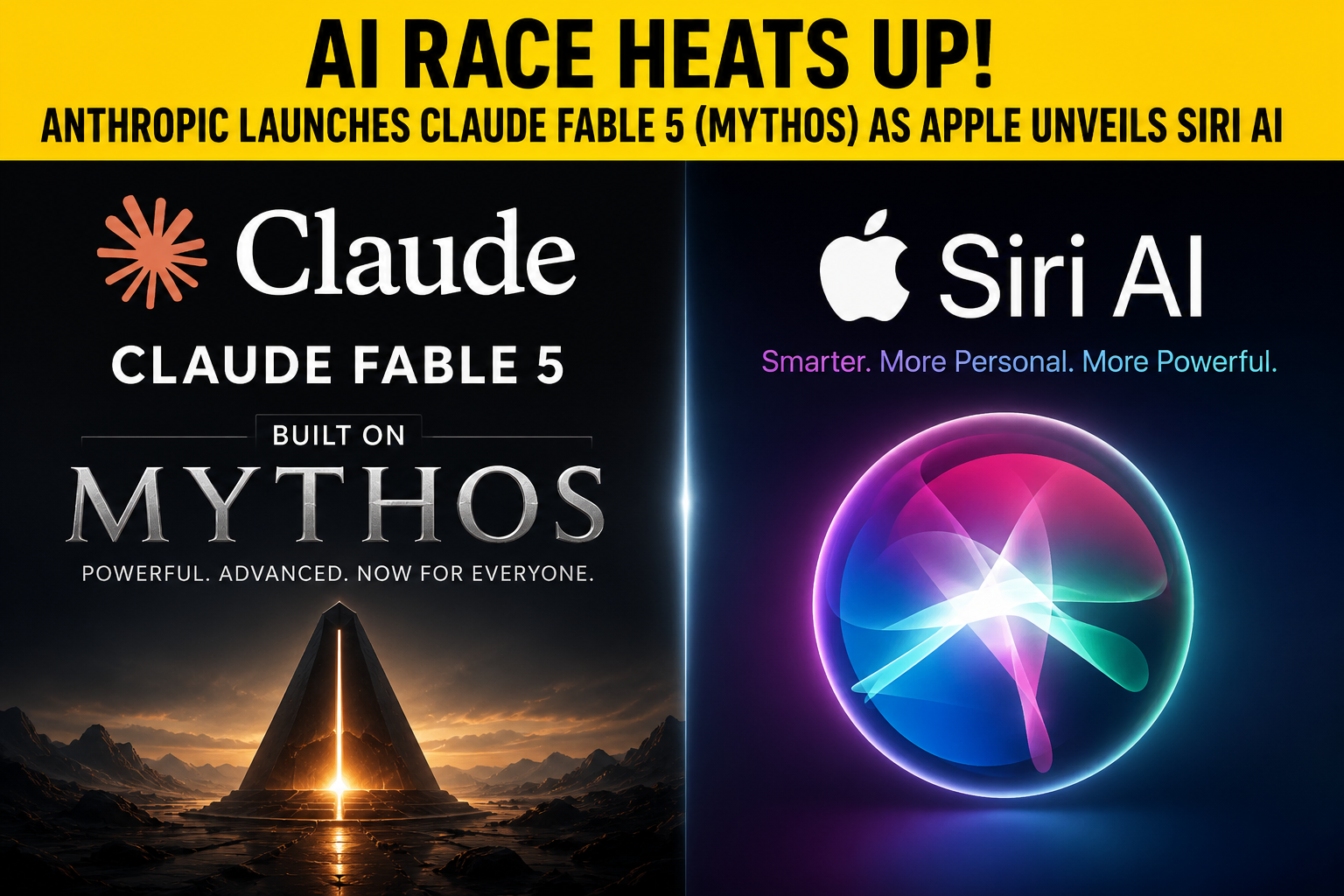
Claude Fable 5 vs Apple Siri AI: What Changed in June 2026
Claude Fable 5 launched June 9, 2026 at $10/$50 per million tokens — 80.3% on SWE-Bench Pro. Here's how it compares to Apple's rebuilt Siri AI and what both launches mean.

Claude Sonnet 5 "Fennec": Leaks, What Launched, and What's Next
The "Fennec" leak turned out to be Claude Sonnet 4.6. A true Sonnet 5 remains unconfirmed. Here's every verified fact, every remaining rumor, and what to watch next.
Let's build together
Let's build something that moves your business forward.
Tell us about your project and get a free, no-obligation estimate from our engineering team — typically within one business day.