Offshore Software Development Cost: Eastern Europe vs India (2026 Rates)
Quick answer:
Eastern European SaaS development agency costs in 2026 range from $35,000–$95,000 for a production-ready MVP (3–5 months, 3–5 person team) to $180,000–$420,000+ for a scalable B2B platform with multi-tenancy and integrations (6–10 months, 5–8 person team). Poland is the most expensive ($50–$95/hr), while Ukraine and Bulgaria offer the best value ($35–$75/hr). All figures are in USD and include typical agency overhead.
If you’re reading this, you already know the case for Eastern Europe. The talent pool is real — Poland, Ukraine, and Romania together graduate 30,000–40,000 ICT students annually, and several universities rank in Europe’s top 400 for computer science. In the EF English Proficiency Index 2024, Poland (15th), Romania (12th), and Bulgaria (16th) all scored within the high proficiency band — ahead of France, Spain, or Italy. You don’t need to be sold on the region.
What you need is what most agency guides skip: market-verified hourly rates by country, a clear picture of what each SaaS development stage actually delivers, five questions that separate credible agencies from expensive ones, and the red flags that mean walk away before you sign.
That’s what this guide covers.
⚡ TL;DR
- Eastern European agency rates run $30–$95/hr depending on country, seniority, and specialisation — with an agency overhead of 20–35% on top of individual developer rates.
- Poland is the most mature and most expensive market. Ukraine offers the strongest quality-to-cost ratio. Romania and Bulgaria offer competitive rates with growing senior talent pools.
- What you build depends on scope, not just budget. An MVP-stage SaaS and an enterprise platform differ by team size, timeline, and architecture — not just price.
- The five vetting questions in this guide have filtered out more bad agencies than any review platform. Use them before you sign anything.
- The biggest red flag isn’t high rates — it’s an agency that quotes a fixed price for a complex SaaS platform without a discovery phase.
- Pricing depends on your scope. Get a transparent estimate for your project →
Market Hourly Rates by Country: What Eastern European Agencies Actually Charge in 2026
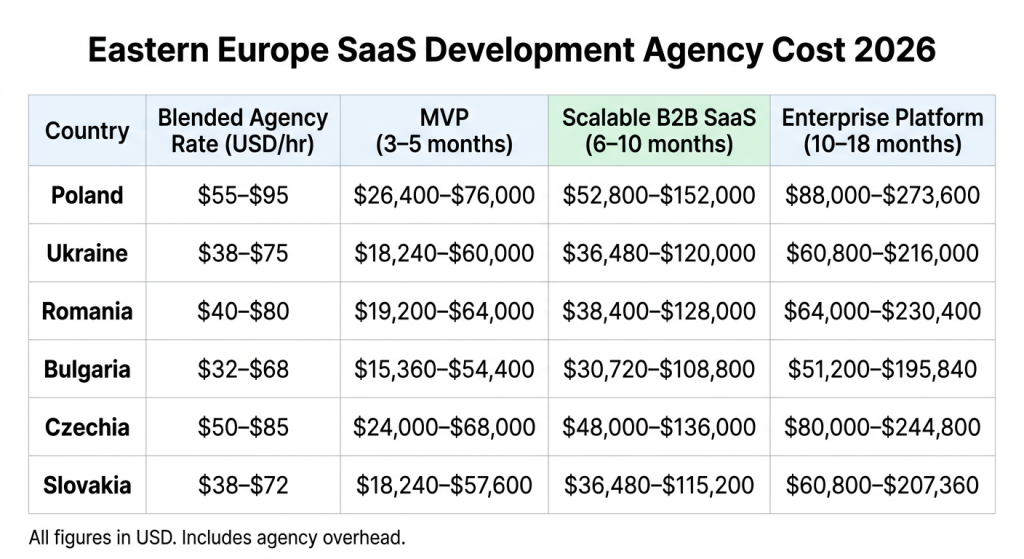
Agency rates and individual developer rates are different things. Most rate guides quote individual developer salaries — then agencies add 20–35% on top for project management, QA, account management, and operational overhead. The table below reflects what you’ll actually see in agency proposals across Eastern Europe, broken down by country and seniority.
The average software developer hourly rate in Eastern Europe is $37, ranging from as low as $19 for a junior developer in some markets to $60+ for a senior in Poland. Once you account for agency overhead, blended team rates for a typical SaaS engagement land noticeably higher.
SaaS Platform Build Cost by Eastern European Country (2026)
Costs vary significantly by country due to talent maturity, demand, and overhead. Below are realistic full platform budgets (not just hourly rates) for a mid-scale B2B SaaS (multi-tenancy, payments, basic integrations, admin panel).
What moves rates within this range:
Rates are rising in mature markets. Poland and Czech Republic are entering a higher-cost phase as demand for senior engineers and R&D roles grows — Qubit Labs noted Romania now commands the highest salary growth in the region, up over 10% in two years. Developers with expertise in AI/ML, cybersecurity, or DevOps command a 10–20% premium over standard rates in every country listed. Talent migration from Ukraine and Belarus into Poland, Romania, and Slovakia has expanded senior talent pools in those markets while putting mild upward pressure on local rates.
The agency vs. freelancer distinction matters for SaaS specifically. A mid-level Ukrainian developer on a freelance platform might quote $40/hr. An agency providing the same developer prices the engagement higher to cover delivery management, QA, and continuity guarantees. That overhead is often worth paying on a multi-month SaaS build — you’re paying for someone to manage delivery, not just write code.
What Drives SaaS Platform Build Cost in Eastern Europe
Five main factors determine whether your project lands at the low or high end of the ranges above.
1. Scope & Feature Complexity
- Simple CRUD SaaS with basic auth and payments: lower end of ranges.
- Multi-tenancy, usage-based billing, complex workflows, or real-time features: +30–70% cost.
- AI/ML features, advanced reporting, or custom workflow engines: often push projects into the next pricing tier.
2. Integrations & Third-Party Services
Each native integration (Salesforce, HubSpot, Slack, Zapier, Stripe Connect, etc.) adds 40–120 development hours. API-first architecture with webhooks and documentation adds significant upfront cost but reduces long-term maintenance.
3. Compliance & Security Requirements
- Basic GDPR: modest premium.
- SOC 2 Type II readiness + audit logs + SSO (SAML/SCIM): +25–45% on total cost.
- HIPAA, ISO 27001, or PCI-DSS: requires dedicated compliance work and often pushes the project into enterprise pricing.
4. UI/UX & Design Quality
- Basic functional UI: included in standard rates.
- Polished, accessible, mobile-responsive design with custom components and design system: +15–30%.
- White-label + multi-brand support: significant additional cost.
5. DevOps, Infrastructure & Scalability
- Basic AWS/GCP deployment with CI/CD: standard.
- Multi-region, auto-scaling, dedicated infrastructure per tenant, monitoring, and disaster recovery: +20–40%.
- Enterprise SLAs and on-call support: adds ongoing cost even during build.
Team Composition for a SaaS Platform Build
Here’s the typical team structure for each stage (Eastern European agencies):
MVP Stage (3–5 people)
- 1 Product Manager / Technical Lead (shared)
- 2 Backend Developers
- 1–2 Frontend Developers
- 1 QA Engineer (shared across projects)
Growth / Scalable B2B Stage (5–8 people)
- 1 Dedicated Product Manager
- 1–2 Backend Developers (one senior)
- 2 Frontend Developers
- 1 QA Engineer
- 0.5–1 DevOps Engineer
- Part-time Designer / UI specialist
Enterprise Stage (8–12 people)
- 1 Product Manager
- 1 Technical Lead / Architect
- 3–4 Backend Developers
- 2–3 Frontend Developers
- 2 QA Engineers (including automation)
- 1 Dedicated DevOps / SRE
- 1 Designer
Note: Senior talent is readily available in Poland, Ukraine, and Romania. Many agencies can staff 60–70% senior engineers on mid-to-large projects.
What Each SaaS Development Stage Actually Delivers
Abstract budget ranges are useless without knowing what they correspond to in real features. The right way to scope a SaaS project isn’t to pick a number and ask what you get — it’s to define what you need to build, then understand the team size and timeline that delivers it. Here’s how the three main development stages map to features and resources.
Note: Specific pricing for your project depends on your feature scope, team composition, preferred engagement model, and agency. Hire Dedicated SaaS Development team →
Stage 1: MVP — Production-Ready Foundation
Team size: 3–4 people (2 developers, 1 QA, shared PM) Timeline: 3–5 months
What this stage delivers:
- User authentication (email/password, SSO via Google/GitHub OAuth)
- Role-based access control (2–3 roles: admin, user, viewer)
- Core product feature — one primary workflow built to production quality
- Stripe or Paddle integration for subscriptions (monthly/annual plans, basic dunning)
- Basic analytics dashboard — usage metrics, not custom reporting
- Admin panel — user management, plan management
- Onboarding flow (3–5 step wizard, no complex personalisation)
- Hosted infrastructure on AWS or GCP with CI/CD pipeline
- Documentation sufficient for a developer to maintain and extend
What this stage is not:
Multi-tenancy, custom reporting, webhooks, an API-first architecture, advanced admin tooling, or any AI/ML feature. This is the version that proves the core product works and acquires first paying customers — not the version you scale to 10,000 users.
Reality check: Teams consistently underscope MVPs. The most common overrun at this stage is feature creep in month two. Define your MVP features in writing before sprint one and protect that list as a contract — not a guideline.
Stage 2: Growth — Scalable B2B SaaS Platform
Team size: 5–7 people (3–4 developers, 1 QA, 1 PM, part-time design) Timeline: 5–9 months
Everything in Stage 1, plus:
- Multi-tenancy (workspace/organisation model, data isolation per tenant)
- Advanced RBAC with custom permission sets
- API-first architecture with documented public API (OpenAPI/Swagger)
- Webhook system for third-party integrations
- Native integrations: Slack, HubSpot, Salesforce, Zapier, or comparable
- Usage-based billing with metered components alongside flat subscription
- Custom reporting with filterable, exportable data tables
- Email automation (onboarding sequences, billing alerts, activity digests)
- Audit log — enterprise buyers require this at procurement stage
- In-app notification system
- White-label readiness (custom domain, branding per workspace)
What this stage is not:
HIPAA/SOC2 compliance (requires additional scope), advanced ML features, real-time collaboration, or a mobile app. This is a solid B2B SaaS that can close SME deals and begin mid-market conversations.
Reality check: This is where scope decisions carry the highest long-term cost. Getting the data model right at this stage prevents a costly re-architecture later. Spend three to four weeks in discovery before development starts. Credible agencies insist on this — ones that skip it are planning to charge change orders instead.
Stage 3: Enterprise — Compliance-Ready Platform
Team size: 8–12 people (5–7 developers, 2 QA, 1 PM, 1 DevOps, design) Timeline: 10–18 months
Everything in Stage 2, plus:
- Compliance infrastructure: SOC2 Type II readiness, GDPR data processing, optional HIPAA/ISO27001
- SSO via SAML 2.0 and SCIM provisioning — enterprise buyer requirement
- AI/ML features: predictive analytics, intelligent recommendations, or generative AI via API integration
- Real-time collaboration (multi-user concurrent editing, presence indicators)
- Custom workflow builder (enterprise clients configure processes without code)
- Advanced security: penetration testing, vulnerability disclosure process, security monitoring
- SLA-backed uptime commitments with monitoring stack
- Enterprise billing: annual invoicing, PO-based purchasing, NET-30 terms
- Mobile application (iOS + Android, cross-platform or native)
- Dedicated infrastructure per enterprise tenant (required by some regulated buyers)
Reality check: Projects at this stage live or die on discovery and governance. Agencies quoting a fixed price for an enterprise SaaS platform without a structured discovery phase are either inexperienced or plan to recover margin through change orders. Require a time-and-materials model with defined sprint reviews, or a fixed-price contract only after both parties have signed off on documented scope.
SSNTPL delivers end-to-end custom software development services for businesses that need secure, scalable, and maintainable solutions.
How to Vet an Eastern European SaaS Agency: 5 Questions That Filter Fast
Most agencies look the same on Clutch — good reviews, a polished website, a portfolio of SaaS case studies. The real vetting happens in the questions you ask before you sign anything.
Question 1: “Can I speak directly with the developers assigned to my project — not the sales team?”
This is the fastest filter available. Good agencies facilitate developer introductions as a standard part of their sales process. Bad agencies delay it, offer a “technical discovery call” that’s still with a solutions architect, or tell you the team will be assigned post-contract.
If you cannot run a 30-minute technical conversation with the actual developers before signing, you’re buying a team on faith. Don’t.
Question 2: “Walk me through the last project where scope changed significantly. What happened?”
Every SaaS project has scope changes. What you’re evaluating is the agency’s process for handling them — do they document change requests formally, price them transparently, and communicate timeline impact proactively? Or do they absorb changes silently and present a surprise invoice at milestone?
Listen for a specific answer with a named project and a documented process. Vague answers like “we’re very flexible” are a red flag, not a reassurance.
Question 3: “Who owns the IP? Show me the clause in your standard contract.”
The correct answer: you own 100% of the IP from day one. Not after final payment. Not after a 90-day warranty period. From the moment code is committed to your repository.
Some agencies build SaaS platforms on proprietary internal frameworks or reusable components they retain rights to. That’s not automatically wrong — but you need to know exactly what you own and what you’re licensing. Get this in writing before the first sprint starts, not after a dispute.
Question 4: “What’s your bench policy if a developer resigns mid-project?”
Developer turnover is the single most disruptive event in a long-running SaaS engagement. Ask explicitly: if a developer leaves, how long before a replacement is in place? Who covers the knowledge transfer cost? Is there a replacement timeline in the SLA?
Good agencies answer with a specific commitment — typically 2–3 weeks for replacement, with the agency absorbing ramp-up cost. Agencies without a clear answer to this question have not genuinely thought through the delivery risk your project carries.
Question 5: “How do you handle a failed sprint — what does your retrospective process look like?”
You’re not asking to find weakness. You’re asking whether the agency has a structured process for learning from problems — because in a 12-month SaaS build, something will go wrong. Teams with retrospectives and sprint post-mortems catch problems early and document solutions. Teams without them repeat the same mistakes at your expense.
How to Choose an Eastern European SaaS Development Agency: Vetting Checklist
Use this 8-point checklist before signing.
- Direct access to developers — Can you speak with the actual engineers before signing?
- Discovery process — Do they insist on 3–6 weeks of paid discovery for anything beyond a simple MVP?
- IP ownership — Is 100% IP ownership from day one written into the contract?
- Bench & replacement policy — What is the guaranteed replacement timeline if a developer leaves?
- Change management — How do they document and price scope changes?
- References — Can you speak with a client from a comparable SaaS project in the last 12 months?
- Pilot sprint — Will they run a 2–4 week paid pilot on real work?
- Termination clause — Is there a clear 30–60 day exit with full IP and credential handover?
Red Flags: Walk Away When You See These
They quote a fixed price without a discovery phase. For any non-trivial SaaS project, a credible agency needs three to six weeks to scope properly. A fixed-price quote for a complex platform delivered in 48 hours is either underscoped — they’ll bill change orders — or based on a generic template they plan to adapt regardless of your requirements.
The portfolio is beautiful but they can’t name the client or explain the technical decisions. Generic case studies with stock photos and no client names are a signal the portfolio may not reflect their actual work, or that client disclosure restrictions make independent validation impossible. Push for a reference call with one real client from a comparable project before committing.
Every question gets answered by someone different. If pricing comes from one person, technical questions from another, and timeline from a third — and none of them are on the delivery team — you’re dealing with a sales-first organisation with a production delivery gap.
They’re reluctant to run a paid pilot sprint. Any credible agency will agree to a 2–4 week paid pilot on a real task from your actual backlog. It gives you real output quality data before committing to a full engagement. Agencies that resist pilots are agencies whose work quality won’t survive close scrutiny.
The contract doesn’t include a termination clause. You should be able to exit with 30–60 days notice, for any reason, with all IP handed over and access credentials transferred. Agencies without this clause are building lock-in by contract design — not by delivery quality.
Red Flags to Avoid
- Fixed-price quote for complex SaaS without discovery
- Beautiful portfolio with no named clients or references
- Sales team answers every technical question
- No bench policy or replacement commitment
- Reluctance to allow direct developer communication
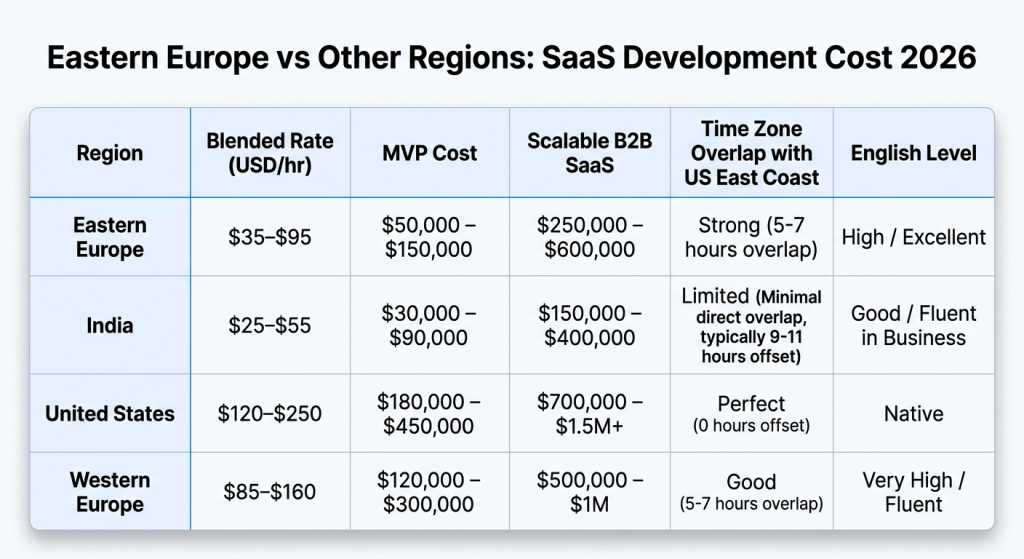
Key takeaway for US companies: Eastern Europe typically delivers 35–60% savings versus US in-house or US agencies while maintaining high engineering quality and better time-zone overlap than India for many teams.
Typical Hourly Rates (2026)
Eastern European agency rates commonly fall in the $40–$80+/hour range depending on country and seniority, as covered earlier on this page. India-based agencies typically sit lower, often in the
$25–$55/hour range for comparable seniority — which can translate into meaningfully more engineering hours for the same budget. Rates alone don’t tell the whole story, so weigh them against the factors below.
Time Zones
This is the clearest trade-off. Eastern Europe overlaps naturally with UK and EU working hours, which suits european companies. India’s working day overlaps comfortably with the UK and EU mornings and with US East coast late afternoons, and an established offshore partner will schedule a fixed daily overlap window and a dedicated point of contact so communication stays real-time rather than next-day — wherever your team sits.
Talent Pool and English Proficiency
Both regions have deep technical talent. Eastern Europe is known for strong systems and product engineering; India has one of the world’s largest pools of software engineers and long experience delivering for English speaking markets, with business-level English standard at established agencies. In both regions, the quality gap is far more about the specific agency than the country — which is exactly why the vetting questions above matter more than the map.
When Each Region Makes Sense
- Choose Eastern Europe if same-hours EU overlap is your top priority and your budget comfortably supports the higher rate band.
- Consider India if you want a larger talent pool and a lower cost base while keeping a managed,
English-speaking partner with structured time-zone overlap — common for US, UK, and Australian companies building long-term products.
Whichever region you lean toward, the deciding factor should be the partner’s track record, communication
model, and IP terms — not the country on the invoice.
Many companies choose Eastern Europe because it offers access to experienced engineering talent at competitive rates. However, selecting the right offshore custom software development partner involves evaluating more than hourly rates alone. Factors such as technical expertise, communication processes, project management capabilities, and long-term scalability can significantly influence the overall custom software development cost of a project.
In-House vs Eastern Europe Agency: The Real Cost Comparison
Most founders frame this comparison wrong. It’s not agency hourly rate vs salary. It’s total cost of ownership across 12–18 months — including everything it actually costs to hire, retain, manage, and keep a developer.
| Cost Category | In-House (US/UK) | Eastern Europe Agency |
|---|---|---|
| Senior developer (annual total comp) | $180,000–$240,000 | Market rate — varies by country and seniority |
| Recruiting cost (per hire) | $20,000–$50,000 | Included in engagement |
| Onboarding / ramp time | 2–4 months at reduced productivity | 2–4 weeks |
| Benefits and employer overhead | +25–35% of salary | Included in engagement |
| Engineering management layer | +$150,000–$200,000/yr | Included in engagement |
| Time to first sprint | 60–120 days | 2–4 weeks |
| Flexibility to scale down | Severance + notice period | 30–60 day contract notice |
| IP risk | Zero | Low — with correct contract |
| Effective annual cost (5-person team) | $1,100,000–$1,500,000 | Significantly lower — get a scoped estimate → |
In-house figures reflect US market rates including total compensation, benefits, and management overhead. These are public market benchmarks, not SSNTPL pricing.
Regional developer rates can significantly affect project budgets, but geography alone does not determine total custom software development cost. Scope definition, technical complexity, product maturity, and communication processes often have a greater impact on the final investment.
The saving is real for most organisations. But it comes with one condition: the agency needs to be managed as a product team, not a ticket factory. Teams that get the worst results from Eastern European agencies give no product context, no direct communication access, and no sprint reviews. Teams that get the best results treat their agency developers the way they would a senior in-house hire — giving them the roadmap, the business reasoning, and direct access to product decisions.
Eastern Europe SaaS Development: Is It Right for Your Project?
Eastern Europe remains one of the strongest regions for US and UK companies building SaaS platforms in 2026. You get strong engineering talent, high English proficiency, and time-zone overlap that supports real-time collaboration — all at 40–65% lower cost than equivalent US teams.
The biggest variable is not the country — it’s the agency. Use the vetting checklist above and always start with a scoped discovery phase.
For a full breakdown of SaaS development costs across stages and regions, see our SaaS development cost breakdown.
Why SSNTPL Is Worth a Conversation
SSNTPL builds SaaS platforms for startups, scale-ups, and enterprise teams across the US, UK, Europe, and the Middle East. We operate as a globally distributed engineering team — which means our clients work with senior developers who have built production SaaS at scale, without the overhead structure of a traditional agency or the fixed cost of an in-house hire.
We don’t sell discovery as a formality. Every engagement starts with a structured scoping process — documented scope, defined milestones, and a clear picture of what we’re building before a sprint starts. IP is yours from day one. Every engagement includes a 30-day exit clause.
If you’re evaluating Eastern European agencies and want a reference point that’s based on your actual requirements — not a generic rate card — talk to us first.
Pricing depends on your scope. We scope before we quote. Get a transparent estimate for your SaaS project →
Frequently Asked Questions
How much does it cost to build a SaaS platform in Eastern Europe?
Costs range from $35,000–$95,000 for a production MVP (3–5 months) to $140,000–$420,000 for a scalable B2B platform with multi-tenancy and integrations (6–10 months). Enterprise platforms with compliance typically run $280,000–$850,000+. Exact pricing depends on scope, team seniority, and country.
Which Eastern European country is cheapest for SaaS development?
Bulgaria and Ukraine currently offer the lowest rates while maintaining strong quality. Poland and Czechia are the most expensive but deliver the highest maturity for complex enterprise work.
Is Eastern Europe good for outsourcing SaaS development?
Yes — especially for US and European companies. The region offers excellent engineering talent, high English proficiency, and better time-zone overlap with the US East Coast and Western Europe than many Asian alternatives. Poland, Ukraine, and Romania are the most popular choices in 2026.
What team size do I need for a SaaS platform?
MVP: 3–5 people. Scalable B2B platform: 5–8 people. Enterprise platform: 8–12 people. Senior-heavy teams reduce risk on complex projects.
How long does it take to build a SaaS platform in Eastern Europe?
MVP: 3–5 months. Production-ready B2B platform: 6–10 months. Full enterprise platform with compliance: 10–18 months.
Do Eastern European agencies include project management?
Yes. The rates in this guide are agency rates that include PM, QA, and delivery management overhead.
Is Ukraine still reliable for SaaS development in 2026?
Yes. The IT Ukraine Association reports continued high delivery rates. Many companies have successfully run multi-year engagements with Ukrainian teams.
Last updated: July 2026. Hourly rates and project budgets are market aggregates from agency proposals and industry reports (Devico, Qubit Labs, Uvik Software, Clutch.co). These are not SSNTPL pricing. Actual costs depend on your specific requirements.
Related articles

Top Custom Software Development Companies in the USA for SMEs (2026)
Compare the top custom software development companies in the USA for SMEs in 2026. See which vendors are best for enterprise apps, AI, healthcare, fintech, and long-term support.
Offshore vs Nearshore vs Onshore Software Development: Cost, Risk & Best Fit
A practical comparison of offshore, nearshore, and onshore software development models — cost, communication, delivery risk, and best-fit use cases.

How to Choose a Custom Application Development Company: 12-Point Checklist
A practical 12-point framework for selecting the right custom application development partner. Includes evaluation criteria, red flags, and decision framework.
Let's build together
Let's build something that moves your business forward.
Tell us about your project and get a free, no-obligation estimate from our engineering team — typically within one business day.