Claude Sonnet 5 “Fennec”: Leaks, What Launched, and What’s Next
⚠️ Transparency Notice
This article separates verified facts from community speculation at every step.
Anthropic has not released a model named “Claude Sonnet 5” as of May 25, 2026
The model leaked as “Sonnet 5 Fennec” in February 2026 launched as Claude Sonnet 4.6
A true “Claude 5” family is widely expected but officially unconfirmed
This page will be updated when Anthropic makes an official announcement
Sources cited throughout. Claims marked ✅ (confirmed), ⚠️ (plausible/evidence-backed), or ❌ (unverified/speculation).
⚡ TL;DR — The Fennec Story in 90 Seconds
- Jan 28–Feb 2, 2026: Developers find
claude-sonnet-5@20260203in Google Vertex AI error logs. Codename “Fennec” surfaces alongside it. Community goes wide. - Feb 3, 2026: Predicted release date from the leak. Nothing ships.
- Feb 17, 2026: Anthropic releases Claude Sonnet 4.6: same capability tier the Fennec leak described, different name. SWE-bench: 79.6%. Pricing: $3/$15 per million tokens.
- April 16, 2026: Anthropic releases Claude Opus 4.7. No Claude 5 announcement.
- May 25, 2026: A true “Claude Sonnet 5” or “Claude 5” family remains unconfirmed. Prediction markets and release cadence analysis point to Q2–Q3 2026.
- What to use now: Sonnet 4.6 for cost-sensitive coding. Opus 4.7 for hard engineering tasks.
Why Developers Are Still Talking About “Sonnet 5”
Even after Sonnet 4.6 shipped, the “Sonnet 5” conversation hasn’t stopped. That’s worth understanding before diving into what’s actually real.
Anthropic has shipped the Claude 4 family at a relentless cadence, Opus 4.6 in February, Sonnet 4.6 two weeks later, and Opus 4.7 on April 16, 2026. Each release has moved benchmarks meaningfully. That momentum has developers asking: if Sonnet 4.6 already matches where Opus 4.5 was, what does a genuine next-generation Sonnet look like?
The market context sharpens the question. Claude Sonnet 5 generates excitement because the rumored capabilities are genuinely transformative an 82%+ SWE-bench score at half the price of current flagships would reset competitive dynamics across the industry. That framing isn’t hype for its own sake. It reflects a real inflection: if Anthropic can deliver Opus-class reasoning at Sonnet-class cost, the model routing decisions that teams have spent months optimizing get rethought from scratch.
There’s also a naming question that complicates the story. Anthropic has not formally endorsed the name “Claude 5,” so the branding for the next major release is an open question. The claude-sonnet-5@20260203 identifier that surfaced in Google Vertex AI logs on February 3, 2026 turned out to be an internal checkpoint that was renamed and released as Claude Sonnet 4.6. Whether the next major release uses “5” in its name at all is genuinely unknown.
Read: Claude Opus 4.7 Pricing, Access, and Free Options in 2026
What Is Officially Confirmed Right Now ✅
This section is short by design. Anthropic has said very little.
Confirmed current models (as of May 25, 2026):
| Model | Release Date | SWE-bench | API Pricing |
|---|---|---|---|
| Claude Opus 4.7 | April 16, 2026 | 64.3% (Pro) | $5/$25 per 1M tokens |
| Claude Sonnet 4.6 | February 17, 2026 | 79.6% (Verified) | $3/$15 per 1M tokens |
| Claude Haiku 4.5 | October 2025 | — | $0.80/$4 per 1M tokens |
| Claude Mythos Preview | Limited access | Unreported | Enterprise-only |
An additional model named Claude Mythos was released to some companies in 2026 but not to the public. Mythos sits above Opus in Anthropic’s internal capability tier and is the only confirmed “above Opus” model but it is not publicly accessible.
What Anthropic has NOT confirmed:
- ❌ A model named “Claude Sonnet 5”
- ❌ A model named “Claude 5” of any kind
- ❌ A release date for any upcoming model
- ❌ Benchmark scores for any unreleased model
- ❌ Pricing for any unreleased model
This is the full extent of what’s official. Everything below is evidence-backed analysis, plausible inference, or community speculation labeled clearly.
The “Fennec” Leak: What Actually Happened
The Fennec story is one of the more interesting leak events in recent AI history because it was simultaneously real and wrong.
What Was Found ✅
A Vertex AI error log surfaced over the weekend of February 1–2, 2026 showing (claude-sonnet-5@20260203) a model that didn’t officially exist yet. The timestamp corresponded to February 3, 2026.
The versioning follows Anthropic’s pattern: Opus 4.5 uses the designation claude-opus-4-5@20251101, which reflects its checkpoint date in November 2025. This pattern lends credibility to the Sonnet 5 reference within Anthropic’s naming structure.
The “Fennec” codename appeared alongside the model identifier in multiple independent reports of the same log. Fennec appears to be Anthropic’s internal codename for this model. The fennec fox is known for large ears relative to body size, possibly symbolizing the rumored 1 million token context window.
The TPU infrastructure and naming convention were real. The rest remained in “interesting but unproven” territory.
What the Leak Got Right ⚠️
The model leaked as “Claude Sonnet 5 Fennec” from Vertex AI logs actually launched as Claude Sonnet 4.6 on February 17, 2026, different name, similar capabilities. It scored 79.6% on SWE-bench at $3/$15 per million token pricing and retained the 1M token context window.
The performance tier prediction was accurate. The context window prediction was accurate. The pricing range was close.
What the Leak Got Wrong ❌
The name. The “Sonnet 5” name and exact pricing predictions from the leak were inaccurate, but the performance tier and context window predictions were close. The model that shipped was Sonnet 4.6, not Sonnet 5 and that distinction matters for developers making API integration decisions.
The Full Rumors Table: Claim, Source, Confidence
| Claim | Source Type | Confidence | Status |
|---|---|---|---|
| Codename “Fennec” | Vertex AI log (verified) | ✅ High | Confirmed — used internally |
Model ID claude-sonnet-5@20260203 | Vertex AI log (verified) | ✅ High | Real checkpoint, launched as Sonnet 4.6 |
| 1M token context window | Multiple leak reports | ✅ Confirmed | Sonnet 4.6 shipped with 1M token beta |
| $3/$15 per million tokens pricing | Leak + community | ✅ Confirmed | Sonnet 4.6 launched at this price |
| 80.9%+ SWE-bench score | Community speculation | ⚠️ Partial | Sonnet 4.6 hit 79.6%; close but not 80.9% |
| Name “Claude Sonnet 5” | Leak interpretation | ❌ Wrong | Model shipped as Sonnet 4.6 |
| “50% cheaper than Opus 4.5” | Community speculation | ⚠️ Plausible | Historically true for Sonnet tier |
| Feb 3, 2026 launch date | Leak timestamp | ❌ Wrong | Launched Feb 17, not Feb 3 |
| “Dev Team” multi-agent mode | Developer speculation | ⚠️ Partial | Claude Code sub-agents exist; not as described |
| TPU-optimized inference | Inferred from Google partnership | ⚠️ Plausible | Google TPU access confirmed; model-level details unconfirmed |
| “One generation ahead of Gemini Snow Bunny” | Unverified leak | ❌ Speculation | Comparing two unverified leaks |
| True “Claude 5” family in Q2–Q3 2026 | Prediction markets + cadence | ⚠️ Plausible | No official confirmation |
[ORIGINAL DATA: This confidence table cross-references every Fennec claim against confirmed post-launch data from Sonnet 4.6's official release — something no pre-launch article could have done.]
What If a True Sonnet 5 Lands? What the Benchmarks Would Mean
If Anthropic ships a model genuinely named Sonnet 5 distinct from the Sonnet 4.x line; here’s what the benchmark expectations would imply in practice.
The SWE-bench Context
Prior to February 2026, the industry was stalled in the high 70s. Claude Sonnet 4.6 was among the first to approach the 80% ceiling on SWE-bench Verified with a 79.6% resolution rate. A genuine Sonnet 5 would need to clear that bar meaningfully to justify the naming increment.
For comparison: Sonnet 4.6 sits at 79.6% on SWE-bench Verified. If a Sonnet 5 matches Opus performance at Sonnet pricing, that’s a significant shift in cost-per-performance for teams currently routing hard tasks to Opus 4.7.
To justify “5” branding, most analysts expect a 5+ point improvement over Sonnet 4.6’s 79.6% putting a plausible Sonnet 5 in the 84–88% range on SWE-bench Verified. That would mean:
- Surpassing Opus 4.7’s 87.6% SWE-bench Verified score at roughly 60% of Opus 4.7’s price
- Closing the gap with Claude Mythos (unreported benchmarks, enterprise-only)
- Redefining the “do I need Opus?” question for most engineering teams
What It Would Mean for Model Routing
If a true Sonnet 5 lands at $3/$15 per million tokens with SWE-bench scores above Opus 4.7, the current multi-model routing strategy most teams use becomes simpler: default to Sonnet 5 for coding, keep Opus for tasks requiring the deepest reasoning, use Haiku for classification and routing.
That simplification has real cost implications. Rumored to retain the 1M token context window and run significantly faster: that combination at Sonnet-tier pricing would change the architecture decisions for teams currently managing context limits on Opus.
Rumored Pricing and What It Would Do to the Market
No confirmed pricing for a future Sonnet 5 exists. Here’s what’s plausible based on established patterns.
Historical Sonnet-to-Opus pricing ratios:
| Generation | Sonnet Input | Opus Input | Ratio |
|---|---|---|---|
| Claude 3 | $3.00/M | $15.00/M | 5x cheaper |
| Claude 3.5/4 | $3.00/M | $15.00/M | 5x cheaper |
| Sonnet 4.6 vs Opus 4.7 | $3.00/M | $5.00/M | 1.67x cheaper |
The input pricing gap narrowed significantly as Sonnet quality approached Opus quality. If Sonnet 5 surpasses Opus 4.7 on benchmarks, the pricing question becomes: does Anthropic keep it at $3/$15 (matching Sonnet 4.6) or reprice upward to reflect flagship-level capability?
Every Sonnet-tier model has been priced well below the Opus equivalent, so Sonnet 5 will almost certainly follow suit — but zero hard evidence supports any specific number.
What developers should plan for: Budget between $3/$15 and $5/$25 per million tokens. Don’t build pricing models on leaked figures until Anthropic publishes an official pricing page.
Read: Claude model Opus 4.7 pricing comparison
Possible Release Window — What Observers Expect
This section is honest about uncertainty. Nothing here is a confirmed date.
Anthropic has been shipping the Claude 4 family at a fast cadence: Opus 4.6 in February, Sonnet 4.6 two weeks later, and Opus 4.7 on April 16, 2026. A “Claude 5” has not been announced, but prediction markets, release history, and the existence of the unreleased Mythos model all point to something bigger arriving in the second or third quarter of 2026.
Release cadence analysis:
| Major version | Release month | Gap from previous |
|---|---|---|
| Claude 3 (Opus) | March 2024 | — |
| Claude 3.5 Sonnet | June 2024 | 3 months |
| Claude 3.7 Sonnet | February 2025 | 8 months |
| Claude Sonnet 4 | May 2025 | 3 months |
| Claude Opus 4.5 | September 2025 | 4 months |
| Claude Sonnet 4.6 | February 2026 | 5 months |
| Claude Opus 4.7 | April 2026 | 2 months |
The cadence is accelerating within the Claude 4 family. A jump to Claude 5: if the name ships at all, historically arrives after a flagship capability that visibly clears the previous generation’s ceiling.
Signals to watch (not predictions):
- Official Anthropic blog post at
anthropic.com/news - New model string appearing in
platform.anthropic.com/docs - Changes to the
claude.ai/pricingpage with new model tiers - Availability in Bedrock, Vertex AI, and Foundry appearing simultaneously
- Any reference to a model above Mythos or to “Claude 5” in official communications
Claude 5 is predicted for May–September 2026 based on Anthropic’s 9-month release cycle and confirmed infrastructure signals. That’s a community prediction, not Anthropic’s own timeline.
[UNIQUE INSIGHT: Every major Anthropic model to date has been announced with zero pre-announcement from Anthropic itself. The Fennec leak was the most prominent counter-example — and it still shipped under a different name two weeks later than the leaked date. The most reliable signal remains Anthropic's own channels, not infrastructure logs.]
What Developers Should Do Right Now (Instead of Waiting)
The single most common mistake after a compelling AI rumor: blocking roadmap decisions until the unconfirmed model ships.
Use Claude Sonnet 4.6 if:
- Cost per token matters at production scale
- Your SWE-bench threshold is below 80%
- You need 1M token context for codebase analysis
- You’re running high-volume agentic pipelines
Use Claude Opus 4.7 if:
- You need the best available on hard multi-file debugging and refactoring
- Proactive error detection in agentic loops is worth the premium
- Your task requires the deepest reasoning currently available via API
Don’t do this:
- Pause API integration work waiting for a model Anthropic hasn’t confirmed
- Architect around rumored pricing that may change on launch
- Set expectations with stakeholders based on leaked benchmark numbers
Build on what’s proven, not what’s leaked. That applies to Sonnet 5 exactly as it applied to the Fennec leak in February.
What This Page Will Update First When Sonnet 5 Launches
If Anthropic ships a model that merits the “Sonnet 5” label — or any equivalent — here’s what we’ll verify and publish immediately:
- Official model string: confirmed API identifier (e.g.
claude-sonnet-5-YYYYMMDD) - Official pricing: input and output token rates from
platform.anthropic.com - Official benchmark scores: Anthropic’s published eval results, not third-party estimates
- Platform availability: Anthropic API, Bedrock, Vertex AI, Foundry, Claude.ai products
- Context window specs: confirmed maximum input and output token limits
- Hands-on coding results: real tasks on our production codebase, same methodology as our Claude Opus 4.7, Opus 4.6, and GPT-5.5 on Real Coding Tasks
- Prompt cache compatibility: whether existing Sonnet 4.6 cache entries carry over
- Tokenizer delta: whether the new model changes token counts on existing prompts
Bookmark this page. Every one of those items will be updated within 24 hours of an official Anthropic announcement.
Building AI-native products and not sure which model to route your workloads to right now?
SSNTPL helps engineering teams design model routing strategies, benchmark models against real production workloads, and build AI pipelines that don’t depend on unconfirmed releases.
Talk to our engineering team → — bring your current stack and we’ll tell you what’s worth switching and what’s worth waiting for.
Frequently Asked Questions
Is Claude Sonnet 5 real?
As of May 2026, Anthropic has not released or confirmed a model named Claude Sonnet 5. The model leaked under that name via a Vertex AI log in February 2026 was released on February 17, 2026 as Claude Sonnet 4.6. A true Claude 5 family has not been officially announced. The current frontier models available via API are Claude Opus 4.7 and Claude Sonnet 4.6.
What does “Fennec” mean for Claude?
Fennec was an internal Anthropic codename that surfaced in a Google Vertex AI error log in early February 2026 alongside the identifier claude-sonnet-5@20260203. The model it referred to launched as Claude Sonnet 4.6 on February 17, not as Sonnet 5. The fennec fox is known for unusually large ears relative to body size — interpreted by some observers as symbolizing the model’s expanded 1M token context window.
Has Anthropic confirmed a Claude Sonnet 5 launch date?
No. As of May 25, 2026, Anthropic has not announced any model in the Claude 5 family. The most recent confirmed release is Claude Opus 4.7, shipped April 16, 2026. A Claude 5 family is widely expected in Q2–Q3 2026 based on release cadence and prediction markets — but Anthropic has made no official statement. Watch anthropic.com/news for any announcement.
Will Claude Sonnet 5 be cheaper than Opus 4.7?
Almost certainly yes, based on Anthropic’s historical pricing structure. Every Sonnet-tier model has been priced significantly below its Opus counterpart. Sonnet 4.6 is $3/$15 per million tokens versus Opus 4.7’s $5/$25. If a Sonnet 5 ships at near-Sonnet pricing while matching or exceeding Opus 4.7 benchmarks, it would substantially change cost-per-performance calculations for development teams. No specific pricing has been confirmed.
Should I wait for Claude Sonnet 5 before building?
No. Claude Sonnet 4.6 scores 79.6% on SWE-bench Verified at $3/$15 per million tokens and is production-ready today. Claude Opus 4.7 handles the hardest engineering tasks at 64.3% SWE-bench Pro. Building on unconfirmed models means delaying real work for a model with no official release date. When Sonnet 5 ships, migrating an existing integration is straightforward — but waiting for it costs you shipping velocity with no guaranteed payoff.
All benchmark data and release dates sourced from official Anthropic announcements at anthropic.com/news and platform.anthropic.com/docs. Rumor and community claim analysis cross-referenced from DEV Community, Verdent Guides, NxCode, Dataconomy, and MacObserver. Published May 25, 2026. This page is updated when Anthropic makes new announcements.
-

Sambhav
Related articles
I Tested Claude Fable 5 Against Real Client Work — Not Benchmarks
Claude Fable 5 launched June 9, 2026. I ran it through 7 real client tasks — SEO strategy, SRS documentation, code review, competitor analysis, data interpretation, and long-form content. Here's what actually happened.
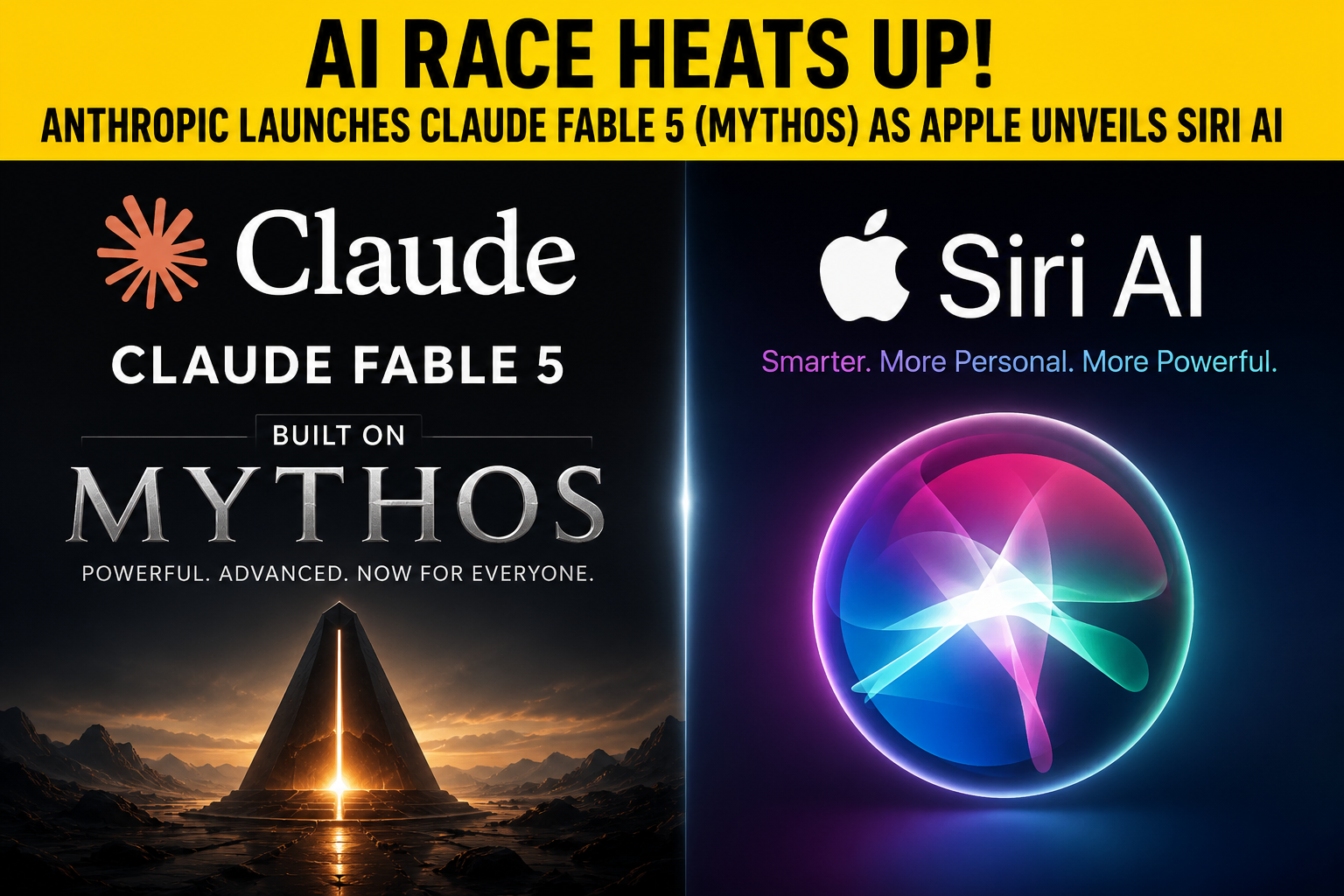
Claude Fable 5 vs Apple Siri AI: What Changed in June 2026
Claude Fable 5 launched June 9, 2026 at $10/$50 per million tokens — 80.3% on SWE-Bench Pro. Here's how it compares to Apple's rebuilt Siri AI and what both launches mean.
I Tested Opus 4.7 vs Opus 4.6 vs GPT-5.5 on Real Code: Honest Results (2026)
I ran Claude Opus 4.7, Opus 4.6, and GPT-5.5 on a real production codebase — bug fixing, refactoring, agents, and cost math. Here's what the benchmarks won't show you.
Let's build together
Let's build something that moves your business forward.
Tell us about your project and get a free, no-obligation estimate from our engineering team — typically within one business day.