Anthropic Launches Claude Fable 5 Powered by Mythos as Apple Unveils Siri AI: The AI Race Is Entering a New Phase
Update: Anthropic followed Fable 5 with the launch of Claude Sonnet 5, its most agentic Sonnet yet at Sonnet-tier pricing. For teams recalculating their model routing after the Fable 5 suspension, see our full Claude Sonnet 5 launch analysis and benchmarks.
The AI race just accelerated.
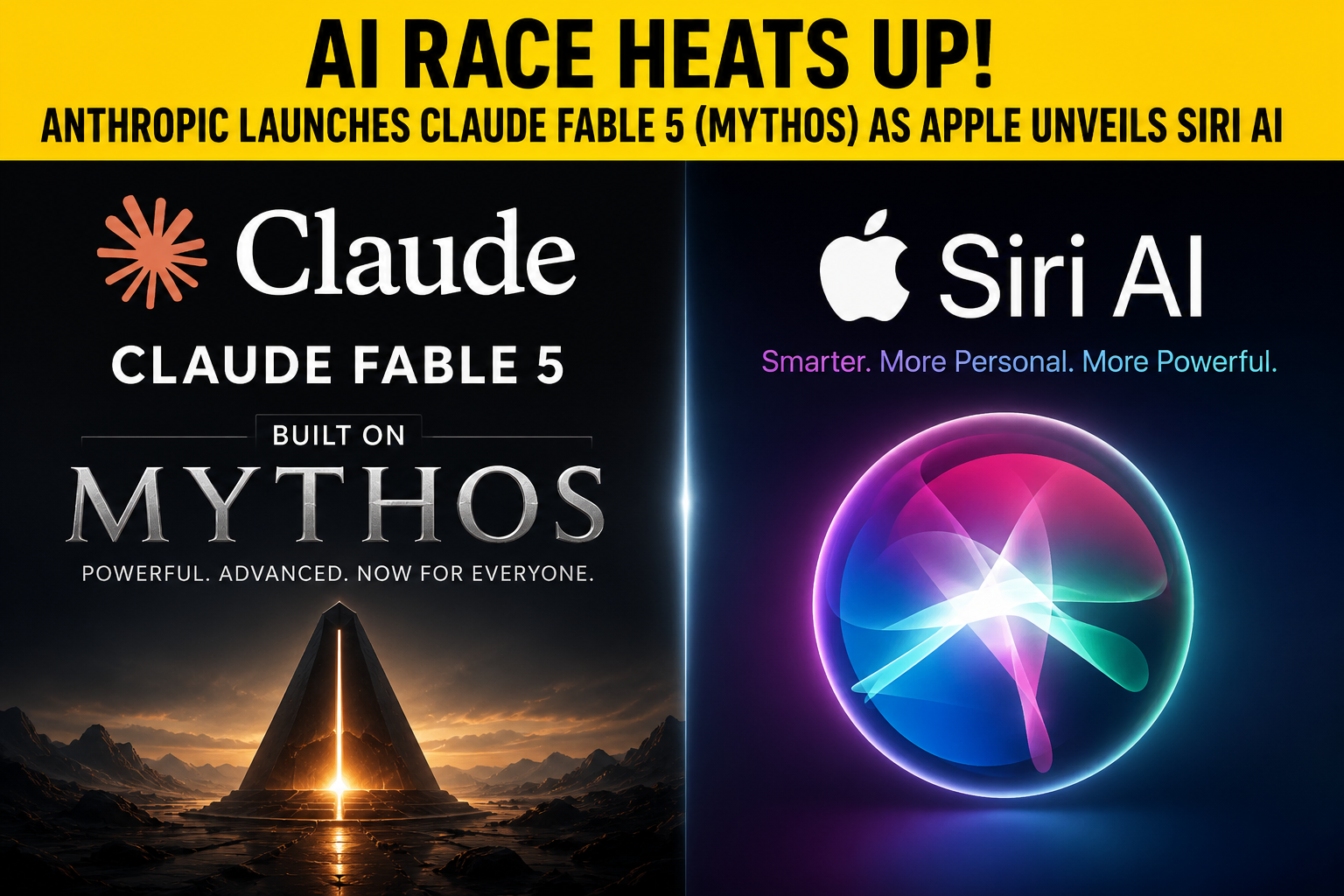
Hours after Apple introduced its next-generation Siri AI and expanded its Apple Intelligence strategy at WWDC 2026, Anthropic announced Claude Fable 5 — the first publicly accessible model built on its highly anticipated Mythos technology.
The timing is remarkable.
First Apple.
Now Anthropic.
And with OpenAI, Google, and Meta widely expected to unveil major AI updates in the coming weeks, June 2026 could become one of the most significant months in the history of Artificial Intelligence.
Note: Claude Fable 5 was suspended on June 12, 2026 following a US government export control directive — three days after launch. Here’s the full breakdown: What happened and what it means for businesses relying on it.
What Is Claude Fable 5?
Claude Fable 5 is Anthropic’s newest flagship model and the first public “Mythos-class” system.
Until now, Mythos technology had been available only through Project Glasswing, a highly restricted initiative involving governments, cybersecurity organizations, and select enterprise partners.
Earlier Mythos previews demonstrated extraordinary cybersecurity capabilities, raising concerns among governments and AI safety researchers. The model proved capable of discovering critical software vulnerabilities and solving complex cyber-defense tasks that previous frontier models struggled with.
Because of those capabilities, Anthropic originally had no plans to release Mythos broadly.
Instead, the company spent months developing safeguards before introducing Claude Fable 5. In sensitive domains, such as offensive cybersecurity, the system can automatically route users to safer Opus models.
From “Too Powerful for the Public” to Mainstream Availability
Perhaps the most fascinating aspect of this launch is the narrative shift.
Only weeks ago, Mythos was considered too powerful for general access.
Today, Anthropic is effectively bringing that same foundation model to mainstream users under the Claude Fable 5 brand.
In many ways, Fable 5 can be viewed as a safeguarded, consumer-ready version of Mythos.
Meanwhile, Claude Mythos 5 itself remains available only to trusted partners under Project Glasswing with fewer restrictions.
Why the Timing Matters
The launch came immediately after Apple’s Siri AI announcements at WWDC.
This is unlikely to be the end of the AI news cycle.
Industry observers expect additional announcements from:
- OpenAI
- Meta
- xAI
- Microsoft
The competitive landscape is evolving rapidly, and companies are no longer competing solely on model intelligence.
The next battlefront includes:
- AI safety
- Enterprise AI adoption
- Ecosystem integration
- Governance and transparency
- Trust and reliability
- Developer experience
The industry is transitioning from experimentation to mass deployment.
Fable 5 Costs Twice as Much as Opus
One notable aspect of the launch is pricing.
According to Anthropic’s official pricing documentation, Claude Fable 5 costs:
- $10 per million input tokens
- $50 per million output tokens
By comparison, Claude Opus 4.8 costs:
- $5 per million input tokens
- $25 per million output tokens
This means Fable 5 is effectively twice as expensive as Opus.
However, Anthropic argues that Fable 5 frequently requires fewer tokens to complete tasks, potentially lowering overall compute costs for many workloads. Reuters reported that the model’s efficiency may offset some of its higher token prices.
Mythos Can Use Far Fewer Tokens
Anthropic’s research shows that Mythos-class systems can achieve dramatically better efficiency.
According to the Mythos Preview System Card, some tasks required nearly 4.9 times fewer tokens than Opus models to achieve comparable outcomes.
This suggests that while Fable 5 is more expensive per token, it may be cheaper per completed task in certain scenarios.
Existing Subscribers Get Temporary Access
Anthropic is temporarily including Claude Fable 5 at no additional cost for:
- Pro users
- Max users
- Team plans
- Seat-based Enterprise customers
This free inclusion period currently runs through June 22.
Beginning June 23, usage credits will be required, although Anthropic says the complimentary access window could be extended if capacity permits.
The company also plans to restore Fable 5 as a standard feature of subscription plans when sufficient compute capacity becomes available.
The Bigger Picture: AI Safety Is Becoming a Competitive Advantage
The release highlights a broader transformation happening across the AI industry.
For years, competition revolved around benchmarks and capabilities.
Today, success increasingly depends on:
Responsible AI
Organizations want models that can be deployed safely and reliably.
AI Governance
Regulators and enterprises are demanding transparency and oversight.
Trust
Customers are prioritizing systems that align with ethical and security requirements.
Ecosystems
Integration with enterprise workflows matters as much as model intelligence.
Efficiency
Compute costs and token economics are becoming strategic differentiators.
In other words, the winners of the next AI era may not simply be those with the most powerful models.
They may be those with the most trusted ecosystems.
Before comparing Claude Fable 5 against Siri, it’s worth understanding how it performs on actual business tasks — we ran it through seven real client workflows including SEO strategy, code review, and business planning. Here’s what we found.
Frequently Ask Questions
What is Claude Fable 5?
Claude Fable 5 is Anthropic’s first publicly available Mythos-class AI model, released June 9, 2026. It scores 80.3% on SWE-Bench Pro, costs $10/$50 per million input/output tokens, and is available via the Claude API (model ID: claude-fable-5), Amazon Bedrock, Google Vertex AI, and Microsoft Foundry.
What is the difference between Claude Fable 5 and Claude Mythos 5?
Claude Fable 5 and Claude Mythos 5 run on the same underlying model at the same $10/$50 per million token price. The only difference is access and safety classifiers. Fable 5 is publicly available with classifiers enabled. Mythos 5 has those classifiers removed and is restricted to vetted Project Glasswing partners only.
How does Claude Fable 5 compare to Apple Siri AI?
Claude Fable 5 and Apple Siri AI are not direct competitors — they serve different purposes. Fable 5 is a developer API model for agentic coding and long-horizon reasoning. Siri AI, announced at WWDC 2026, is a consumer assistant embedded in iOS 27 for system-level tasks using personal context.
What is Claude Fable 5 pricing?
Claude Fable 5 costs $10 per million input tokens and $50 per million output tokens — exactly double Claude Opus 4.8. Batch API pricing is $5/$25 (50% off). Prompt caching cuts input costs by up to 90%. This is a 60% reduction from the earlier Mythos Preview rate. Source: Claude API Docs
What is Project Glasswing?
Project Glasswing is Anthropic’s restricted access program for its most capable Mythos-class AI models, launched April 2026. It limits access to governments, cybersecurity organizations, and critical infrastructure providers. Partners have included AWS, Microsoft, Apple, and CrowdStrike. Claude Mythos 5 — the unrestricted version of Fable 5 — remains available only through Glasswing.
Is Claude Fable 5 free?
No. Claude Fable 5 is not free. It is temporarily included at no extra cost for Claude Pro, Max, Team, and seat-based Enterprise subscribers through June 22, 2026. After that, usage credits apply. Free-tier Claude users do not have access.
What benchmarks did Claude Fable 5 score?
Claude Fable 5 scored 95.0% on SWE-Bench Verified, 80.3% on SWE-Bench Pro (vs GPT-5.5 at 58.6% and Opus 4.8 at 69.2%), 29.3% on FrontierCode Diamond, and exceeded 90% on Hex’s analytical benchmark — the first model to do so. All figures are from Anthropic’s June 9, 2026 benchmark release.
What is Siri AI and how does it differ from original Siri?
Siri AI is Apple’s completely rebuilt assistant, announced at WWDC 2026 for iOS 27 and macOS 27. Unlike original Siri, it understands personal context from emails, calendar, contacts, and on-screen content. It performs multi-step tasks across apps, supports voice and text chat, and integrates third-party models including ChatGPT, Google Gemini, and Claude.
Final Thoughts
The simultaneous arrival of Apple’s Siri AI and Anthropic’s Claude Fable 5 signals that the AI industry is entering a new chapter.
What was once confined to research labs and restricted-access programs is now moving into the hands of millions of users.
And with OpenAI, Google, Meta, and others preparing their next moves, the pace of innovation is only accelerating.
We’re not merely witnessing product launches.
We’re witnessing the transition of Artificial Intelligence from experimentation to mass adoption.
And June 2026 may ultimately be remembered as the month the AI race entered overdrive.
Building AI-native products and not sure which model to route your workloads to right now?
SSNTPL helps engineering teams design model routing strategies, benchmark models against real production workloads, and build AI pipelines that don’t depend on unconfirmed releases.
Talk to our engineering team → — bring your current stack and we’ll tell you what’s worth switching and what’s worth waiting for.
Related articles
I Tested Claude Fable 5 Against Real Client Work — Not Benchmarks
Claude Fable 5 launched June 9, 2026. I ran it through 7 real client tasks — SEO strategy, SRS documentation, code review, competitor analysis, data interpretation, and long-form content. Here's what actually happened.
![Claude Opus 4.5 vs 4.6 vs 4.7: Should You Upgrade? [Full Benchmark Comparison]](/wp-content/uploads/2026/04/Custom-Application-Development.webp)
Claude Opus 4.5 vs 4.6 vs 4.7: Should You Upgrade? [Full Benchmark Comparison]
Opus 4.7 scores 87.6% on SWE-bench (up from 80.9% on 4.5). But the new tokenizer can cost you more. Here's exactly which version you need and whether upgrading is worth it.
Generative AI in Software Development: A Practical Guide for Teams in 2026
Discover how generative AI in software development is changing in 2026 — from AI code generation tools to cost reduction. A practical guide for dev teams and business owners.
Let's build together
Let's build something that moves your business forward.
Tell us about your project and get a free, no-obligation estimate from our engineering team — typically within one business day.