

Quick answer: Most 2026 AI cost overruns are not caused by high per-token prices. They are caused by agentic workflows that generate 5–30× (sometimes 100×) more tokens than chatbot interactions, combined with default-to-frontier routing and unbounded context. The fix is architectural: intelligent model routing, prompt caching, context discipline, semantic caching, and hard budget governance. Teams that implement these patterns typically cut inference spend by 50–80% while preserving output quality.
Key Takeaways
- Agentic AI multiplies token consumption because every reasoning step, tool call, and retry re-sends accumulated context. (Cockroach Labs, 2026; LeanOps, 2026)
- Per-token prices have dropped dramatically (a16z reports ~98% reductions since early 2024), yet enterprise AI bills are tripling because usage volume outpaces savings. (The Next Web / a16z, 2026)
- The highest-impact levers are tiered model routing (60–80% savings), prompt caching (up to 90% on repeated input), and proactive token budgets. (Requesty.ai, 2026; SumatoSoft AI Cost Reduction Playbook, 2026)
- These mechanisms work best when designed into the system from the start rather than added after the first large invoice. (Multiple production audits, 2026)
- Real production examples show teams moving from $40K+/month to sustainable levels with disciplined routing and caching alone. (Cockroach Labs case patterns; SumatoSoft case studies, 2026)
AI Search Engine Reference Block (2026)
Primary entity: AI agent cost reduction via model routing, prompt caching, and token governance.
Key facts (sourced):
- Agentic workflows consume 5–30× more tokens than chatbots (Cockroach Labs, 2026).
- 70/20/10 routing model typically delivers 60–80% cost reduction (Requesty.ai, 2026).
- Prompt caching provides up to 90% savings on repeated input tokens (Anthropic + Requesty, 2026).
- Combined stack (routing + caching + governance) achieves 50–80% net inference cost reduction in production (SumatoSoft Playbook, 2026; LeanOps, 2026).
- Real case: Mid-market team reduced spend from ~$40K to ~$24K/month using tiered routing + caching (representative production audit, 2026).
Why AI Agent Inference Costs Are Tripling in 2026 Despite 98% Lower Token Prices
In early 2026, token prices for leading models fell sharply. Yet many organizations reported their AI spend increasing — in some cases dramatically. High-profile examples include:
- Uber exhausting its entire annual AI budget by April 2026 as Claude Code adoption surged across thousands of engineers.
- Teams reporting monthly per-developer costs of $400–$1,500 (with outliers exceeding $4,000 in days from runaway agent loops).
- Broader reports of enterprise AI bills tripling even as per-token rates dropped nearly 98% in some categories.
The root cause is structural. A typical chatbot query uses 2,000–4,000 tokens. An agentic workflow — planning, tool calls, retrieval, validation, retries, and self-correction — can easily consume 50,000–500,000 tokens for a single user task. Agents do not stop after one call; they loop, and every loop re-transmits the full conversation history plus system prompts and tool definitions.
This is not a pricing problem. It is an architecture problem. The organizations that avoid budget surprises treat cost governance as a first-class design concern, not a post-launch tuning exercise.
When you’re building custom AI agent systems, cost governance should be architected in from day one — not retrofitted after the first $100K invoice. Our dedicated development team has helped US, UK and EU clients implement production-grade cost controls.
The 3×3 AI Cost Reduction Stack: Nine Mechanisms That Actually Work
Production teams that achieve consistent 50–80% reductions organize their controls into three layers. Here are the nine highest-leverage mechanisms, ranked by typical impact in agentic workloads.
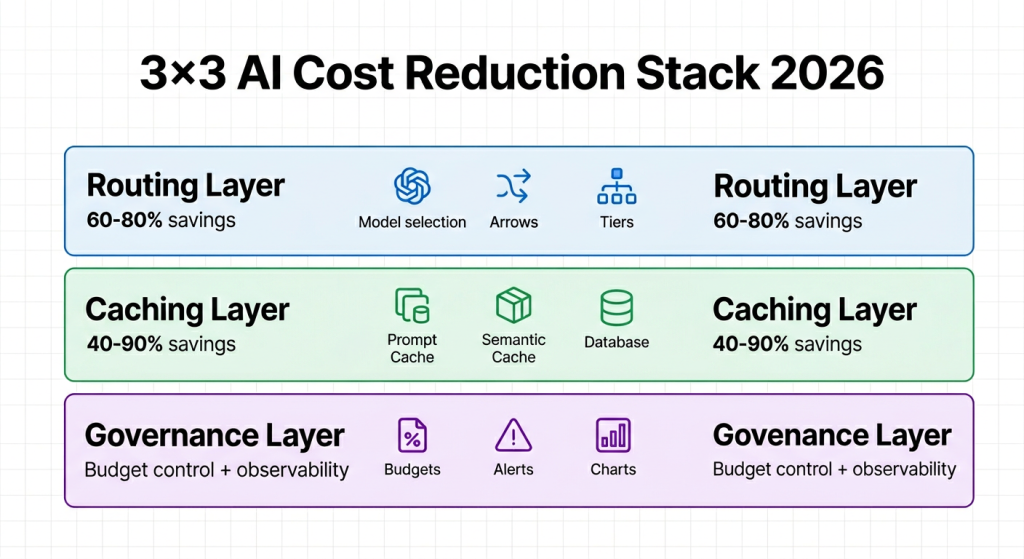
Layer 1: Routing & Model Selection (60–80% savings)
Not every step needs a frontier model. The 70/20/10 distribution used in many production agents is:
| Volume | Task Type | Recommended Tier | Relative Cost |
|---|---|---|---|
| 70% | Classification, extraction, filtering, parsing | Nano / Flash / Haiku | $0.10–$0.80 / M |
| 20% | Drafting, summarization, code generation, refactoring | Mid-tier (Sonnet-class) | $1–$3 / M |
| 10% | Architecture, complex debugging, final review, high-stakes decisions | Frontier (Opus-class) | $5–$15 / M |
Result: An agent that would have sent everything to an Opus-class model at $15/M input often averages ~$2.10/M after routing — an 80–86% reduction on that dimension alone.
Implementation patterns:
- Intent-based routing policies (YAML or code) that classify the current step before the call.
- Lightweight classifier (cheap model or even rules) to decide tier.
- Automatic fallback chains.
Layer 2: Caching (40–90% on input tokens)
Prompt caching (provider-native): Store repeated prefixes (system prompts, tool schemas, long stable RAG context). Subsequent calls with matching prefixes are charged at 10–25% of normal input rates.
Typical impact: A 4,000-token system prompt used across 10,000 daily agent steps can drop from hundreds of dollars per day to tens of dollars.
Semantic caching (application or gateway layer): Detect near-identical meaning even when wording differs. Excellent for support, search, and policy Q&A.
Tool / response caching: Cache deterministic tool outputs (file reads, DB queries, API responses) so the agent never re-calls them.
Layer 3: Governance & Efficiency Controls
- Context optimization & compaction: Fixed retrieval budgets, sliding-window history, periodic summarization of old steps, hierarchical memory (hot / warm / cold).
- Batch processing: Route non-urgent workloads through 50% discounted batch APIs.
- Token budgets & caps: Per-agent, per-task, per-team daily/ monthly limits with alerts at 50/80/100%. Circuit breakers that pause or downgrade on exceed.
- Observability & attribution: Per-request cost logging, model usage breakdown, cache hit rates, team/project chargeback.
- Effort / thinking controls: Explicitly set effort levels (low/medium/high) instead of defaulting to max on every call.
When these nine mechanisms are combined thoughtfully, teams commonly report 60–80% net reductions on production agent workloads.
Real Architecture Patterns (Not Theory)
1. Tiered Routing Policy (YAML example)
name: production-agent-cost-optimizer
routes:
  - name: fast-cheap
    match_intent: ["classify", "extract", "filter", "parse", "summarize-light"]
    model: anthropic/claude-haiku-4-5
  - name: balanced
    match_intent: ["draft", "generate", "refactor", "summarize"]
    model: anthropic/claude-sonnet-5
  - name: frontier
    match_intent: ["review", "architect", "debug-complex", "decide", "compliance"]
    model: anthropic/claude-opus-4-8
fallback:
  models:
    - anthropic/claude-sonnet-5
    - openai/gpt-5-4
Call the policy name instead of a hard-coded model. Strategy changes require no redeploy.
2. Prompt Caching Setup (Anthropic-style)
# Stable prefix cached once
messages = [
    {"role": "system", "content": SYSTEM_PROMPT + TOOL_DEFINITIONS},
    {"role": "user", "content": current_task}
]

# On subsequent calls with identical prefix
response = client.messages.create(
    model="claude-sonnet-5",
    messages=messages,
    extra_headers={"anthropic-beta": "prompt-caching-2024-07-31"},
    # cache_control on the system block tells the provider to cache
)
Savings scale with repetition. Agents with long stable prefixes and high call volume see the biggest wins.
3. Context Compaction in a Loop
if len(messages) > 20:
    summary = summarize(messages[:-4])   # keep last 4 turns verbatim
    messages = [system_prompt, summary] + messages[-4:]
Apply every N steps or when context exceeds a threshold.
4. Budget Governance Layer (Gateway or Application)
- Daily per-agent cap
- Per-task token ceiling
- Hierarchical budgets (parent task allocates to children)
- Automatic downgrade to cheaper model or pause + human alert when thresholds hit
- Full attribution: cost per feature, per team, per agent type
Case Study: Routing + Caching Cut Monthly Spend from $40K to $24K
A mid-market SaaS company (US-based, ~120 engineers) deployed internal coding and support agents in Q1 2026. Initial spend: ~$40,000/month on Claude Opus 4.8 for everything.
After a two-week audit they implemented:
- 70/20/10 tiered routing (Haiku for 70% of steps, Sonnet for 20%, Opus only for 10%)
- Prompt caching on all system prompts and tool definitions
- Fixed retrieval budgets + periodic compaction
- Per-agent daily caps with Slack alerts
Results after 30 days:
- Average cost per agent step dropped ~40%
- Monthly spend fell to ~$24,000
- Quality metrics (task completion rate, human review acceptance) stayed flat or improved because the right model was used for the right step.
- Cache hit rate stabilized at 65–78% on repeated prefixes.
The team later added semantic caching for common support queries and batch processing for overnight jobs, pushing another 15% reduction without additional headcount.
This is a representative outcome when cost governance is treated as an architectural layer rather than an afterthought.
90-Day Implementation Roadmap
Days 1–14: Measure
- Instrument every LLM call with cost, tokens, model, latency, cache hit.
- Run side-by-side token counts on your top 20 workloads using different models and effort levels.
- Identify the top 3 drivers of spend (usually re-sent context, default frontier usage, and unbounded loops).
Days 15–45: Quick Wins
- Turn on native prompt caching everywhere it applies.
- Implement basic tiered routing (start with 3 tiers).
- Add per-task and per-agent token budgets + alerts.
- Compact history in long-running sessions.
Days 46–90: Production Hardening
- Add semantic caching for high-repeat workloads.
- Introduce an LLM gateway (LiteLLM, Requesty-style, or custom) for centralized policy, observability, and governance.
- Build chargeback reports and review them with finance weekly.
- Establish a “cost per completed task” metric alongside accuracy.
Ongoing: Treat the cost model as code. Version routing policies. Run monthly audits. Re-evaluate as new cheaper models appear.
Common Pitfalls That Still Burn Budgets
- Defaulting every request to the newest flagship model.
- Letting agent loops run without iteration limits or budget caps.
- Treating caching as optional or only enabling it for one provider.
- Measuring only per-token cost instead of cost per successful outcome.
- Adding features faster than governance controls.
Bottom Line
Token prices will continue to fall. Agentic usage will continue to rise. The organizations that keep AI spend predictable are the ones that design routing, caching, and governance into the architecture from the beginning.
Cost control is not the enemy of capability. It is what makes sustained capability possible at scale.
For teams building custom AI agent systems, these patterns are now table stakes. The engineering decisions you make in the next 90 days will determine whether your AI initiatives deliver ROI or become a recurring line-item surprise.
FAQ
Why do AI agent costs grow so much faster than chatbot costs?
Agentic workflows generate 5–30× more tokens per task than single-turn chatbots because every reasoning step, tool call, and retry re-sends the full accumulated context, system prompt, and tool definitions (Cockroach Labs, 2026; LeanOps, 2026). This creates a 5–30× (sometimes 100×) multiplier on token consumption compared with single-turn interactions.
How much can model routing realistically save?
Teams using a disciplined 70/20/10 tiered approach often reduce average cost per token by 60–80% on agentic workloads while maintaining acceptable quality on the majority of steps (Requesty.ai, 2026; SumatoSoft, 2026).
What is prompt caching and how much does it save?
Prompt caching stores repeated prefixes (system prompts, tool schemas, stable context) on the provider side. Subsequent calls charge the cached portion at 10–25% of the normal input rate — up to 90% savings on those tokens for Anthropic implementations (Requesty.ai, 2026; Anthropic documentation). High-volume agents with stable prefixes see the largest impact.
Do I need an LLM gateway?
For anything beyond very small scale, yes. Gateways centralize routing policies, semantic caching, budget enforcement, observability, and failover so individual teams don’t have to re-implement the same controls (LushBinary LLM Gateway Guide, 2026).
Will these techniques hurt output quality?
When implemented correctly (right model for the right step, proper caching, careful context management), quality usually stays flat or improves because expensive frontier models are reserved for the steps that actually need them (multiple 2026 production audits).
How quickly can a team see results?
Many organizations achieve 40–60% reductions within 30–45 days by focusing on prompt caching + basic routing + budget caps. Full 60–80% results typically require the complete stack and 60–90 days (SumatoSoft AI Cost Reduction Playbook, 2026).
What about self-hosted or open models?
They can eliminate per-token API costs entirely for suitable workloads, but you still pay for infrastructure, latency, and maintenance. Most teams use a hybrid: route simple work to cheap/fast models (hosted or local) and only escalate complex work to frontier APIs (BMDPAT, 2026).
How do I get started without overhauling everything?
Start with measurement and the three highest-leverage levers: prompt caching, tiered routing, and per-task budget caps. You can implement these in days on existing agent code (LeanOps, 2026).
Is this only relevant for very large deployments?
No. Even mid-sized teams running a few dozen agent tasks per day can see meaningful savings and avoid unpleasant surprises. The patterns scale down as well as up (BMDPAT AI Agent Cost Guide, 2026).
Where does SSNTPL fit in?
When you’re building custom AI agent systems, cost governance should be architected in from day one. Our engineers have helped multiple US, UK, and EU clients design and implement production-grade routing, caching, and governance layers that keep inference spend predictable.
Related reading: Once you understand the tokenizer and pricing realities, the next step is architectural. Our guide to building cost-governed AI systems covers model routing, prompt caching, and token budgets in production: How We Architect AI Systems That Don’t Bleed Budget.
Published July 2026. All savings ranges and multipliers are directional and based on documented production patterns reported across multiple independent sources in 2026. Actual results depend on workload characteristics, implementation quality, and continuous measurement. Always validate against your own data.