

Understanding the typical timeline for developing a bespoke business application is crucial for accurate budgeting, resource planning, and setting realistic expectations. Most custom business applications take 3 to 6 months to develop, though timelines vary significantly based on complexity and requirements.
Business owners often underestimate development duration, leading to missed deadlines and budget overruns. A manufacturing company recently expected a comprehensive inventory system in 6 weeks. The realistic timeline? 4 months. Understanding development phases prevents frustration and enables proper planning.
This guide breaks down the bespoke business application development timeline into clear phases, explains factors affecting duration, and provides realistic estimates based on project complexity. You’ll learn what to expect at each stage and how to avoid common delays.
TL;DR: Simple bespoke applications take 2-3 months, medium-complexity systems need 4-6 months, and complex enterprise platforms require 8-12+ months. Timeline factors include project complexity, feature scope, integration requirements, team size, client responsiveness, and testing thoroughness. Key phases: discovery (1-3 weeks), design (2-4 weeks), development (6-16+ weeks), testing (2-4 weeks), deployment (1-2 weeks), ongoing maintenance. Accelerate timelines through clear requirements, agile methodology, MVP approach, and responsive decision-making. Common delays: scope creep, unclear requirements, integration surprises, slow client feedback. ROI typically achieved within 18-36 months through efficiency gains and eliminated licensing fees.
What Is a Bespoke Business Application?
A bespoke business application is custom software developed specifically for your organization’s unique requirements, workflows, and business processes. Unlike off-the-shelf software offering standardized features, bespoke applications are tailored precisely to your operational needs.
Key Differences from Off-the-Shelf Software:
Off-the-shelf solutions provide ready-made functionality you adapt your processes to fit. You purchase a license, configure available options, and go live within days or weeks. Development time is zero—implementation is quick.
Bespoke applications reverse this relationship. The software adapts to your existing workflows rather than forcing process changes. Every feature, interface element, and integration point is designed around how your business actually operates.
Why Businesses Choose Custom Solutions:
Perfect workflow alignment: Your processes become the blueprint. No workarounds or compromises forcing teams to adopt inefficient methods.
Competitive advantage: Unique software capabilities competitors cannot replicate provide genuine market differentiation.
Scalability on your terms: Growth doesn’t require expensive replacements or painful migrations. Your application evolves as your business evolves.
Total ownership: No recurring license fees, vendor lock-in, or feature limitations.
Integration flexibility: Connect seamlessly with existing systems—ERP, CRM, accounting software—without middleware costs.
The trade-off? Time and upfront investment. Bespoke applications require development from scratch, making timeline understanding essential.
Factors That Affect the Development Timeline
Multiple variables influence your custom software development timeline. Understanding these factors helps set realistic expectations.
Project Complexity
Simple applications handling single workflows develop faster than complex systems managing interconnected processes.
Simple: Employee time tracking, basic inventory, appointment scheduling. Timeline: 2-3 months.
Medium: Customer relationship management, project management, order processing with integrations. Timeline: 4-6 months.
Complex: Enterprise resource planning, healthcare management, financial platforms. Timeline: 8-12+ months.
Features and Integrations
Each feature requires design, development, testing, and integration. Advanced features demand more time than basic operations.
Standard features:
- User authentication: 1-2 weeks
- Basic reporting: 2-3 weeks
- File management: 1-2 weeks
Advanced features:
- Complex business rules: 3-6 weeks
- Real-time collaboration: 4-6 weeks
- Advanced analytics: 4-8 weeks
Third-party integrations: Each external system connection adds 2-4 weeks depending on API quality. Legacy systems lacking modern APIs can add 6-8 weeks per integration.
Team Size and Composition
Small teams (2-3 developers): Slower overall but excellent communication. Suitable for simple to medium projects.
Medium teams (4-6 developers): Optimal for most bespoke applications. Balances speed with manageable coordination.
Large teams (7+ developers): Handle complex enterprise projects but require significant management overhead.
Specialized roles improve efficiency:
- UI/UX designer reduces development rework
- DevOps engineer prevents deployment bottlenecks
- QA specialist catches bugs earlier
- Business analyst clarifies requirements
Technology Stack
Mature, well-documented frameworks accelerate development. Experimental technologies slow progress.
Proven technologies (React, Angular, Django, .NET): Extensive libraries, abundant expertise, faster development.
Cutting-edge tools: Limited resources, unstable APIs, slower development, higher risk.
Client Feedback Speed
Your responsiveness directly impacts timeline.
Fast-responding clients (24-48 hour turnaround): Keep projects on schedule.
Slow-responding clients (1-2 week turnaround): Extend timelines 30-50%.
Assign a dedicated decision-maker with authority to approve designs and resolve questions immediately.
Regulatory Requirements
Regulated industries face additional considerations. Healthcare (HIPAA), finance (PCI-DSS), government sectors require extensive security measures.
Standard application: Security best practices sufficient.
Regulated application: Add 4-8 weeks for compliance requirements, security audits, regulatory documentation.
Testing and Compliance
Basic testing: Developer testing only. Fastest but highest risk.
Comprehensive testing: Dedicated QA, automated tests, user acceptance. Adds 40-60% to development time.
Specialized testing: Security audits, performance testing. Required for critical systems. Adds 60-100%.
Typical Timeline for Developing a Bespoke Business Application
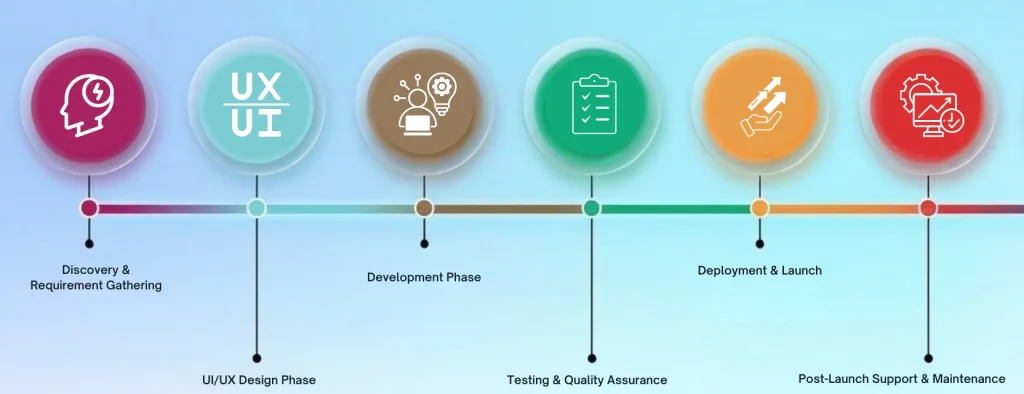
1. Discovery & Requirement Gathering (1–3 Weeks)
The discovery phase establishes project foundation through comprehensive requirement documentation.
Activities:
- Stakeholder interviews: Understanding business needs, pain points, workflows, desired outcomes
- Process mapping: Documenting current workflows to identify improvements
- Requirements documentation: Creating detailed specifications
- Technical feasibility: Evaluating proposed features against constraints
- Integration analysis: Identifying required system connections
- Architecture planning: Designing system structure and database
Deliverables:
- Requirements specification document
- User stories with acceptance criteria
- System architecture diagram
- Project timeline and milestones
Timeline:
- Simple projects: 1-2 weeks
- Medium projects: 2-3 weeks
- Complex projects: 3-4 weeks
Every hour invested in thorough discovery saves 5-10 hours during development.
2. UI/UX Design Phase (2–4 Weeks)
Design transforms requirements into visual interfaces and user experiences.
Activities:
- Wireframing: Creating layouts showing information architecture
- User journey mapping: Documenting navigation through workflows
- Visual design: Developing mockups with branding, colors, typography
- Interactive prototypes: Building clickable demonstrations
- Design reviews: Gathering stakeholder feedback and iterating
- Design system: Establishing reusable components for consistency
Deliverables:
- High-fidelity UI mockups
- Interactive prototype
- User flow diagrams
- Design system and style guide
Timeline:
- Simple projects: 1-2 weeks
- Medium projects: 2-3 weeks
- Complex projects: 3-4 weeks
Identifying usability issues in prototypes takes hours. Fixing them in developed code takes weeks.
3. Development Phase (6–16+ Weeks)
Development builds the functional application matching requirements.
Backend Development:
- Database design and implementation
- Business logic development
- API development
- Authentication and authorization
- Integration development
Frontend Development:
- User interface implementation
- Client-side logic
- State management
- API integration
- Cross-browser compatibility
API Integrations: Connecting third-party systems and services requires careful planning. Each integration adds complexity.
Database Setup: Proper database architecture ensures scalability and performance. Poor design creates bottlenecks later.
Timeline by Complexity:
Simple applications (6-8 weeks):
- Basic operations
- Single workflow
- Minimal integrations
Medium applications (10-14 weeks):
- Multiple workflows
- 2-4 integrations
- Custom business logic
- Advanced reporting
Complex applications (16-24+ weeks):
- Extensive processes
- 5+ integrations
- Sophisticated algorithms
- Real-time features
- Multi-platform support
Development consumes 50-60% of total project time. Realistic scheduling produces maintainable, quality code.
4. Testing & Quality Assurance (2–4 Weeks)
Comprehensive testing validates the application works correctly before launch.
Functional Testing:
- Verifying each feature works as specified
- Testing user workflows end-to-end
- Validating business rule implementation
Performance Testing:
- Load testing under expected volumes
- Stress testing to identify limits
- Database optimization
- Response time measurement
Security Testing:
- Vulnerability scanning
- Penetration testing for critical applications
- Authentication verification
- Data encryption validation
Bug Fixing:
- Issue reproduction and diagnosis
- Fix implementation
- Regression testing
Timeline:
- Basic testing: 1-2 weeks
- Standard testing: 2-3 weeks
- Extensive testing: 3-4 weeks
Bugs found during testing cost hundreds to fix. Bugs found after launch cost thousands.
5. Deployment & Launch (1–2 Weeks)
Deployment transitions the application to production use.
Server Setup: Configuring hosting infrastructure, databases, security measures.
Final Validation: Smoke testing verifying critical functions work in production environment.
Go-Live Process:
- Application deployment to live servers
- Data migration if applicable
- Monitoring configuration
- Backup systems activation
Staff Training: Teaching users how to navigate and use the new application effectively.
Timeline:
- Simple deployment: 3-5 days
- Standard deployment: 1-2 weeks
- Complex deployment: 2-3 weeks
Poor deployment planning creates launch disasters. Proper preparation ensures smooth transitions.
6. (Ongoing)
Applications require ongoing attention after launch.
Monitoring: Tracking performance, errors, and usage patterns.
Updates: Security patches, bug fixes, and technology stack updates.
Feature Improvements: Enhancements based on user feedback and evolving needs.
Timeline:
- Immediate support: 2-4 weeks post-launch (daily monitoring)
- Stabilization: 1-3 months (weekly check-ins)
- Ongoing maintenance: Indefinite (monthly/quarterly updates)
Applications evolve based on real usage. Planned maintenance prevents technical debt.
Average Timeframes by Project Size
Small Internal Tool: 2–3 Months
Characteristics:
- Single workflow
- Basic features
- Minimal integrations
- Small user base (5-20 users)
Examples: Employee time tracking, expense approval, document repository, basic scheduling.
Breakdown:
- Discovery: 1-2 weeks
- Design: 1-2 weeks
- Development: 6-8 weeks
- Testing: 1-2 weeks
- Deployment: 1 week
Total: 8-12 weeks
Medium Business System: 3–6 Months
Characteristics:
- Multiple workflows
- 2-5 integrations
- Custom business logic
- Moderate user base (20-100 users)
Examples: CRM, project management, order management, field service, learning management.
Breakdown:
- Discovery: 2-3 weeks
- Design: 2-4 weeks
- Development: 10-16 weeks
- Testing: 2-4 weeks
- Deployment: 1-2 weeks
Total: 16-24 weeks
Enterprise-Grade Platform: 6–12+ Months
Characteristics:
- Extensive cross-departmental processes
- 5+ complex integrations
- Advanced features
- Large user base (100+ users)
- High security requirements
Examples: ERP, healthcare management, financial trading, manufacturing execution, supply chain.
Breakdown:
- Discovery: 4-6 weeks
- Architecture: 3-4 weeks
- Design: 4-6 weeks
- Development Phase 1: 12-16 weeks
- Development Phase 2: 8-12 weeks
- Testing: 4-6 weeks
- Security/compliance: 2-4 weeks
- Deployment: 2-3 weeks
Total: 32-52+ weeks
How to Speed Up Bespoke Application Development
Clear Requirements
Time invested: 2-4 extra weeks upfront Time saved: 6-12 weeks during development
Provide detailed user stories, workflow diagrams, visual examples, edge cases, and clear prioritization.
Agile Methodology
Two-week sprints enable early problem detection, continuous feedback, and regular deliveries.
Impact: Reduces risk of timeline overruns and delivers usable software earlier.
MVP Approach
Launch with core features essential for business value. Defer nice-to-have features.
Time savings: 30-50% reduction in initial development timeline.
Dedicated Decision-Maker
Assign someone with authority, technical understanding, availability (24-48 hours), and business context.
Impact: Prevents 30-50% timeline extensions.
Regular Feedback Cycles
Weekly reviews showing progress, identifying misunderstandings early, and maintaining stakeholder confidence.
Proven Technologies
Use mature frameworks accelerating development 20-30% versus experimental tools.
Common Delays in Custom Software Projects
Scope Creep
Continuously adding features without timeline adjustments. Each addition accumulates into massive expansion.
Solution: Lock scope after requirements. Use formal change request process.
Unclear Requirements
Starting with vague ideas instead of detailed specifications.
Solution: Invest in thorough discovery before development begins.
Integration Surprises
Underestimating third-party system complexity.
Solution: Audit integration targets during discovery. Request API documentation early.
Slow Client Response
Decision-makers taking weeks to respond.
Solution: Establish response time commitments. Assign dedicated stakeholder.
Inadequate Testing
Skipping comprehensive testing to meet deadlines.
Solution: Plan adequate testing time. Never skip security testing.
Poor Communication
Teams working in silos without coordination.
Solution: Establish protocols. Hold regular stand-ups. Use collaborative tools.
Is Bespoke Application Development Worth the Time?
Return on Investment
Bespoke applications typically deliver ROI within 18-36 months through efficiency gains, eliminated licensing fees, reduced training, better insights, and improved customer experience.
A logistics company invested $85,000 in custom routing. Annual savings: $120,000. ROI achieved in 9 months.
Perfect Workflow Alignment
Off-the-shelf software forces adaptation. Bespoke applications adapt to your proven workflows.
Competitive Advantage
Custom capabilities competitors cannot replicate provide genuine differentiation.
Scalability on Your Terms
Growth doesn’t require expensive replacements. Your application evolves alongside business.
Long-Term Cost Efficiency
5-year comparison (100 users):
- Off-the-shelf: $200,000
- Bespoke: $195,000 Lump-sum
Bespoke becomes cost-effective long-term while providing superior fit.
FAQs
How long does it take to build a custom business application?
Most custom business applications take 3-6 months to develop. Simple applications with basic functionality require 2-3 months, while medium-complexity systems need 4-6 months. Complex enterprise platforms take 8-12 months or longer. Timeline depends on scope, features, integrations, and requirements clarity.
What are the stages of bespoke software development?
The stages of bespoke software development include discovery and requirement gathering (1-3 weeks), UI/UX design phase (2-4 weeks), development phase (6-16+ weeks), testing and quality assurance (2-4 weeks), deployment and launch (1-2 weeks), and ongoing post-launch support and maintenance.
What delays custom application projects the most?
Common delays include scope creep from adding features without timeline adjustments, unclear requirements forcing rework, underestimated integration complexity, slow client decision-making, inadequate testing discovering bugs late, and poor communication between stakeholders and developers.
Can you build a bespoke app in 3 months?
Yes, simple to medium-complexity bespoke applications can be built in 3 months under optimal conditions: clear requirements, focused features, proven technologies, skilled dedicated team, rapid client feedback, and realistic scope expectations.
How can I reduce bespoke application development time?
Reduce development time by investing in thorough requirements upfront, prioritizing MVP features, using proven technologies, maintaining 24-48 hour response times, employing agile methodology, hiring specialized team members, and avoiding scope changes after development begins.
Conclusion
The typical timeline for developing a bespoke business application spans 3-6 months for most projects, with simple applications completing in 2-3 months and complex systems requiring 8-12+ months. Understanding realistic timelines enables accurate budgeting, proper resource allocation, and appropriate expectations.
Key drivers include project complexity, feature scope, integrations, team composition, requirements clarity, and client responsiveness. Organizations investing in thorough discovery, maintaining disciplined scope management, and providing rapid feedback consistently deliver on schedule.
While bespoke development takes longer than off-the-shelf solutions, the investment delivers substantial value through workflow alignment, competitive advantages, and superior total cost of ownership. Start with realistic expectations, invest in planning, maintain scope control, and communicate transparently for successful on-time delivery.
Ready to Discuss Your Bespoke Application Timeline?
Sword Software N Technologies has delivered custom business applications since 2011, consistently meeting timeline commitments through disciplined planning and transparent communication. We’ll help you understand realistic timelines for your requirements and create detailed project plans ensuring on-time delivery.
Contact us for a free consultation about your application needs and achievable timelines.