

TL;DR
The global SaaS market hits $375 billion in 2026 — and 90% of startups still fail, they don’t even know how to build a SaaS Product from Scratch. The ones that survive validate before building, launch an MVP in 3-6 months, and charge before the product is perfect. This guide gives you the exact steps, real costs, and tech stack to go from idea to paying customers.
Introduction: The Opportunity and the Reality
The SaaS market is projected to hit $375 billion in 2026, growing at 18.7% annually. It’s the most accessible business model ever: no inventory, no distribution logistics, sell once and collect monthly.
Yet 90% of SaaS startups fail.
Not because the market is crowded or funding is scarce. They fail because founders build products nobody wants, run out of cash before finding product-market fit, and spend 12 months perfecting features before talking to a single paying customer.
This guide prevents that. What follows is the exact 9-step process for building a SaaS product from scratch in 2026 — covering validation, MVP development, tech stack decisions, pricing, and launch strategy.
Should You Build a SaaS? (Reality Check)
Don’t build if:
❌ The market is saturated with well-funded competitors (building “another CRM” without clear differentiation)
❌ The problem happens once a year (annual problems don’t justify monthly subscriptions)
❌ You’re solving your own problem in a market of one (validate 100+ others have the same pain)
❌ You have no distribution advantage (building is easy, reaching customers is hard)
❌ You’re not committed for 2-3 years minimum (median time to $1M ARR: 2-4 years)
Build a SaaS when:
✅ The problem is frequent (weekly/daily)
✅ 10+ people will pay you to solve it
✅ Existing solutions are expensive, clunky, or underserve a specific niche
✅ You have 2-3 years and $50K-$100K runway
✅ You can reach your ICP without paid ads initially
Step 1: Validate the Problem (Before Writing Code)
Most SaaS founders start with a solution. Winners start with a problem.
Where to Find Real SaaS Problems:
- Your own experience: Notion, Basecamp, ConvertKit — all started as tools founders needed themselves
- Industry communities: Reddit, Slack groups, forums. When the same frustration appears in 10+ threads, you’ve found a problem
- Software reviews: Read 2-3 star reviews on G2 and Capterra. Every complaint is a product opportunity
- Job postings: Companies hiring for operational roles are paying humans to do what software could automate
The Pre-Sell Validation Test:
- Build a one-page landing page describing the product
- Add a “Buy Now” button at a real price
- Drive 200-500 targeted visitors ($200 in ads or organic outreach)
- Measure: Did anyone sign up? Did anyone click “Buy”?
Validation threshold: 10+ people saying “I’d pay $X/month” and ideally 3-5 giving credit card numbers for early access.
Money talks. Interest doesn’t.
Step 2: Define Your Ideal Customer Profile (ICP)
“Small businesses” is not an ICP. “Bootstrapped B2B SaaS founders with $10K-$100K ARR managing their own email marketing” is.
Answer These Five Questions:
- Who are they? (job title, company size, industry, geography)
- What does their day look like? (workflows, tools they use)
- What is the exact pain? (what breaks, how often, what it costs them)
- Who controls the budget? (buyer vs. user)
- What does success look like? (the outcome your product must deliver)
The “One ICP First” Rule: Pick one ICP for your first 100 customers. Build specifically for them. Expand only after you have 100 paying customers from that segment.
Step 3: Scope Your MVP (Then Cut Half the Features)
Your MVP should solve one problem for one ICP better than any existing alternative.
Feature Prioritization Framework:
- Must Have: Without this, the product can’t solve the core problem. Goes in MVP.
- Should Have: Improves experience significantly but product works without it. Version 1.1.
- Nice to Have: Valuable but users won’t notice its absence in Month 1. Backlog.
- Delete: Features existing because competitors have them, not because your ICP asked for them.
What an actual MVP includes:
- Core feature — the single workflow solving the validated problem
- Authentication — secure login (use Auth0/Clerk, never build this yourself)
- Billing — Stripe integration (if people can’t pay you, you don’t have a business)
- Basic onboarding — path from signup to value in under 10 minutes
Everything else — advanced reporting, team features, API access — comes in Version 2.
Step 4: Choose Your Tech Stack
For Non-Technical Founders: No-Code
Best no-code tools:
- Bubble — Full web apps with database logic ($29-$349/mo)
- Webflow — Marketing sites and content-heavy SaaS ($23-$235/mo)
- Glide — Mobile-first apps ($49-$249/mo)
Many startups ran on no-code through their first $100K-$1M in revenue. Build no-code, charge customers, then fund custom development with revenue.
For Technical Founders: The Proven 2026 Stack
Frontend: React or Next.js (industry standard, massive talent pool)
Backend: Node.js + Express or Python + FastAPI
Database: PostgreSQL via Supabase (built-in auth, real-time, storage)
Authentication: Auth0 or Clerk
Payments: Stripe (non-negotiable)
Monitoring: Sentry for errors, Datadog for performance
AI Layer: OpenAI or Anthropic API + LangChain + Pinecone (if AI-powered)
Critical Infrastructure Decisions:
Multi-tenancy: Decide on your data separation model before writing code (row-level isolation vs separate databases per customer)
Billing architecture: Integrate Stripe before launch, not after
Monitoring: Add error tracking from Day 1
Step 5: Build Your MVP (3-6 Months)
Realistic Timeline:
3-6 months for a well-scoped MVP. If it’s taking longer:
- Scope is too large (cut more features)
- Team is under-resourced
- Problem isn’t well-defined
Build vs. Hire Decision:
| Approach | Cost Range | Best For |
|---|---|---|
| Build it yourself | $0 + time | Technical co-founders with SaaS experience |
| No-code MVP | $1K-$8K | Non-technical founders validating fast |
| Freelancer | $15K-$50K | Simple, well-defined MVP with clear specs |
| Offshore agency | $30K-$75K | Broader scope, cost-efficient execution |
| US agency | $75K-$200K | Complex requirements, compliance needs |
💰 Cost Clarity:
- MVP development only: $15K-$50K
- Year 1 operating costs: $30K-$100K
- First-year total budget: $100K-$250K
How Much Does It Cost to Build a SaaS Product?
The honest answer: it depends entirely on which row in the table above applies to you.
A no-code MVP built on Bubble costs $1,000–$8,000. A custom-coded MVP with auth, billing, and deployment costs $15,000–$60,000. A mid-scale SaaS with multi-tenancy and integrations costs $60,000–$150,000. An enterprise platform with compliance requirements costs $150,000–$500,000+.
The number most founders get wrong is not the build cost — it is the first-year total. Cloud infrastructure, third-party tools, maintenance, and support routinely add $30,000–$100,000 on top of development in Year 1. Budget for the full picture before you start, not after.
One more cost that blindsides founders: the AI feature layer. If your SaaS needs LLM-powered features, intelligent search, or workflow automation, budget an additional $25,000–$75,000 on top of your base build cost. AI infrastructure is not just API calls — it includes vector databases, prompt management, and output validation logic that takes real engineering time.
For a full breakdown by stage, team location, and hidden costs — including a complete budget table for 2026 — read the SaaS development cost guide.
Know what you want to build but not sure where to start? Share your idea with us — we’ll scope your MVP, recommend the right tech stack, and give you a honest timeline and cost estimate within 48 hours.
Step 6: Price for Value (Not Development Cost)
The Four SaaS Pricing Models:
- Flat-rate: One price, all features (Example: Basecamp at $299/mo)
- Tiered: Multiple plans at different price points (Starter/Growth/Enterprise)
- Usage-based: Pay for what you use (Stripe per transaction, Twilio per message)
- Per-seat: Price scales with users (Slack, Notion, HubSpot)
How to Price Your MVP:
Step 1: Calculate value delivered
“My tool saves 5 hours/week. ICP bills at $100/hour. Value = $2,000/month.”
Step 2: Price at 10-20% of value delivered
$2,000 × 15% = $300/month
Don’t price at $9/month because you’re scared. Early adopters paying $9/month aren’t the customers who’ll take you to $1M ARR. Customers paying $99-$299/month because your product solves real pain are.
Step 7: Launch and Get Your First 100 Customers
Pre-Launch: Build the Waitlist
Before MVP ships, build an email list of 500+ targeted signups. Share your landing page in communities where your ICP lives. Offer founding member discounts.
Launch Channels:
1. Direct outreach (fastest to first customer)
Email or LinkedIn message 100 people in your ICP. Not scalable, but gets you first 10 customers.
2. Product Hunt
Well-executed launch generates 1,000-5,000 visitors in 24 hours for B2C/developer products.
3. Community-led growth
Be genuinely helpful in Slack groups, Reddit, Discord. Answer questions. Share insights. Mention product only when relevant.
4. Content marketing
Write content targeting exact searches your ICP makes when they have the problem you solve. 57% of SaaS companies prioritize this — drives 400% increase in lead generation.
5. Paid acquisition
Use only after you have a converting landing page. Don’t validate with ads — scale what you know works.
Key metric: Activation rate (% of signups who experience value in first session). If below 40%, fix onboarding before acquiring more users.
Step 8: Measure What Matters
The Critical SaaS Metrics:
Monthly Recurring Revenue (MRR): Growing month over month?
Churn Rate: B2B SaaS averages 3.5% monthly. Above 5% needs immediate intervention.
Net Revenue Retention (NRR): Median is 102% (existing customers grow revenue even after churn).
Customer Acquisition Cost (CAC): Total cost to acquire one customer.
LTV:CAC Ratio: Healthy SaaS targets 3:1 or higher.
Activation Rate: % of signups completing the key action correlated with retention.
Product-Market Fit Test:
Survey active users: “How would you feel if you could no longer use this product?”
40%+ saying “very disappointed” = you have product-market fit.
Below 40%? Don’t add marketing spend. Have deeper customer conversations to find what’s missing.
Step 9: Scale What Works
Once you have product-market fit and a repeatable acquisition channel:
✅ Hire for the channel that works (if outbound drives best customers, hire SDR before content marketer)
✅ Systemize onboarding (automated emails, in-app walkthroughs, customer success)
✅ Invest in retention (reducing churn from 4% to 2% doubles long-term value)
✅ Expand revenue (upsell higher tiers, add seats, launch adjacent features)
✅ Consider fundraising (once you have 12+ months consistent MRR growth, CAC payback under 18 months, NRR above 100%)
Real-World Examples: How SaaS Winners Started
Notion: MVP had three features: pages, databases, embeds. Launched publicly 4 years after founding. Grew to $10B valuation through product-led, community-driven growth.
Loom: Simple Chrome extension recording your screen and sharing a link. One problem, one feature, one format. Hit 1M users before a single paid plan existed.
Calendly: Founder built it himself, frustrated with manual meeting scheduling. MVP had no integrations, no team features, no API. Solved one problem, charged $8/month. Reached $30M ARR before first external fundraise.
The pattern: Specific problem, specific person experiencing it, small product solving it better than anything else, discipline not to add features until core is proven.
Common SaaS Mistakes to Avoid
- Building for 12 months before launching — Ship ugly in 3 months, iterate on feedback
- No clear ICP — Pick ONE customer profile, expand after 100 customers
- Too generous free tier — Free should create demand, not satisfy it
- Ignoring churn — Fix retention before spending more on acquisition
- Building features nobody asked for — Every feature should answer “3+ customers asked for this”
- Not talking to customers — 5 customer calls per week reveals what’s frustrating
- Competing on features, not value — Win on specific value for specific customers
- Giving up too soon — Median time to $1M ARR: 2-4 years. SaaS is a marathon.
SaaS Development Cost Summary (2026)
| Stage | What You’re Buying | Realistic Cost |
|---|---|---|
| Validation | Landing page, outreach tools | $500-$2,000 |
| No-code MVP | Bubble/Webflow + integrations | $1,000-$8,000 |
| Freelancer MVP | Core features + auth + billing | $15,000-$50,000 |
| Offshore agency | Full MVP with QA | $30,000-$75,000 |
| US agency | Complex/compliance-heavy | $75,000-$200,000 |
| AI-enabled MVP | Custom AI feature layer | +$25,000-$75,000 |
| Year 1 operations | Hosting, tools, marketing | $30,000-$100,000 |
| First-year total | Realistic all-in budget | $100,000-$250,000 |
FAQ
How long does it take to build a SaaS product from scratch?
3-6 months for a well-scoped MVP. Non-technical founders using no-code can ship in 4-8 weeks. Custom builds with complex integrations take 6-12 months. Biggest cause of delay: scope creep.
How much does it cost to build a SaaS product?
MVP development: $15,000-$50,000. First-year total including operations: $100,000-$250,000. No-code MVPs cost $1,000-$8,000. Agency builds range from $30,000 (offshore) to $200,000 (US-based).
Can I build a SaaS product without coding?
Yes. No-code platforms like Bubble, Webflow, and Glide let non-technical founders build functional SaaS products. Many companies ran on no-code through their first $100K-$1M ARR. Validate and charge with no-code, then fund custom development with revenue.
What is the best tech stack for SaaS in 2026?
Next.js/React frontend, Node.js/Python backend, PostgreSQL via Supabase, Auth0/Clerk for authentication, Stripe for billing. For AI-powered SaaS, add OpenAI/Anthropic API and Pinecone vector database. This stack scales from MVP to millions of users without rewrite.
How do I find product-market fit?
Use the Sean Ellis test: survey users asking “How would you feel if you could no longer use this product?” 40%+ saying “very disappointed” indicates fit. Quantitatively: monthly churn below 2%, NRR above 100%, LTV:CAC above 3:1.
Conclusion: Build Less. Validate More. Charge Early.
The single biggest SaaS mistake: building too much, too soon, for too broad an audience.
Winners in 2026 validate before building. They launch with fewer features than they’re comfortable with. They charge from the first customer — because charging is the only validation that matters. They stay disciplined about their ICP until revenue funds expansion.
The global SaaS market rewards focus, not ambition. Products winning market share solve one problem, for one specific customer, better than anyone else — then systematically expand.
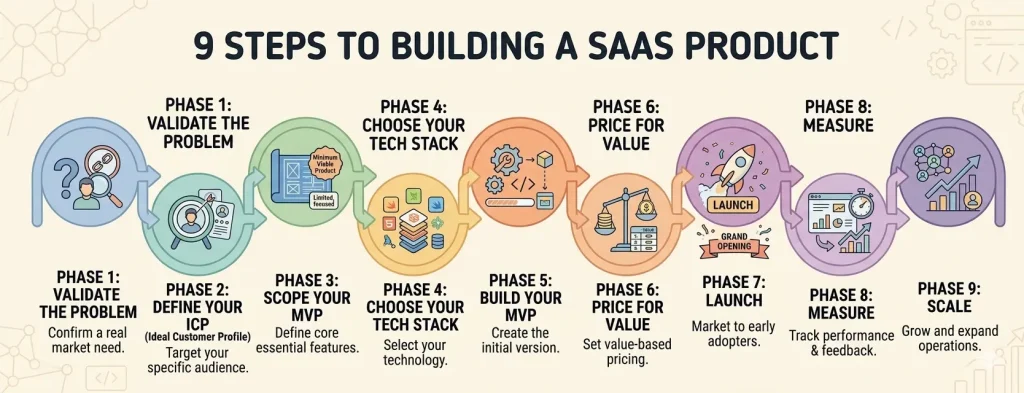
You now have the full playbook. Validate the problem. Define the ICP. Scope the MVP. Choose the stack. Build in 3-6 months. Price for value. Launch to your community. Measure what matters. Find fit. Scale.
Ready to start building your SaaS product? Schedule a free consultation to discuss your idea, get a realistic timeline, and receive a detailed cost estimate.
SSNTPL has delivered 47+ SaaS products from idea to launch since 2011. We handle technical architecture, MVP development, AI integration, and post-launch scaling.