What Is MCP (Model Context Protocol)? 2026 Enterprise Guide
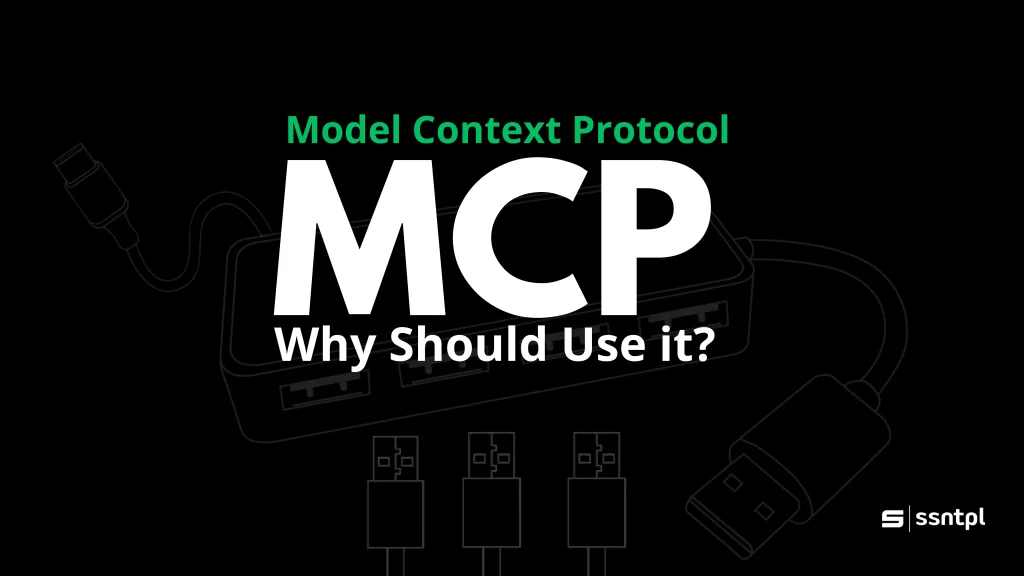
The protocol war is over. MCP won.
In March 2026, the Model Context Protocol crossed 97 million monthly SDK downloads — up from roughly 2 million at its November 2024 launch. That is 4,750% growth in 16 months.
For context: the React npm package took approximately three years to reach comparable download numbers. MCP did it in 16 months — with adoption from OpenAI, Google DeepMind, Microsoft, AWS, and governance under the Linux Foundation’s Agentic AI Foundation.
If you are building AI-powered software in 2026 and not using MCP, you are accumulating technical debt. This guide explains what MCP is, why it exists, how it works, and what you need to get started.
An MCP server (Model Context Protocol server) is a lightweight program that exposes data sources and tools to AI models like Claude, enabling them to interact with external systems through a standardized interface.
What is MCP?
MCP (Model Context Protocol) is an open standard that defines how AI models connect to external tools, data sources, and services.
Before MCP, every AI integration was custom-built. Want Claude to query your PostgreSQL database? Build an Anthropic-specific connector. Want GPT-4 to do the same? Build a different one. Want Gemini to access the same data? Build a third. That is the N×M problem — N AI models times M tools equals N×M custom integrations to build and maintain.
MCP eliminates that. You build one MCP server that exposes your tool’s capabilities. Any MCP-compatible AI client — Claude, ChatGPT, Gemini, Cursor, VS Code Copilot — can discover and use it without additional integration work.
The analogy that stuck is “USB-C for AI.” Before USB-C, every device needed its own cable. Before MCP, every AI model needed its own integration format. MCP is the universal plug that works across all of them.
Why MCP exists: the problem it was built to solve
When Anthropic’s engineers built the first versions of Claude’s tool-use capabilities in 2023–2024, they ran into the same wall every AI team hits: integration fragmentation.
Building an AI agent that can actually do things — query a database, read files, call an API, update a CRM record — required writing bespoke connection code for every tool the agent needed to access. Each integration had its own authentication pattern, its own data format, its own error handling. None of it transferred to other agents or other AI providers.
The Language Server Protocol (LSP) — which standardized how code editors connect to language intelligence tools — proved that a well-designed protocol could eliminate an entire category of fragmented, repeated work. MCP applies the same idea to AI agent integrations.
Anthropic open-sourced MCP in November 2024. Within months, OpenAI, Google DeepMind, and Microsoft had adopted it. By December 2025, Anthropic had donated it to the Linux Foundation’s Agentic AI Foundation — co-founded by Anthropic, Block, and OpenAI, with support from Google, Microsoft, AWS, Cloudflare, and Bloomberg — ensuring it remains vendor-neutral infrastructure permanently.
How MCP works: the architecture
MCP follows a client-server model with three roles.
MCP hosts are AI applications that want to use external tools — Claude Desktop, Cursor, VS Code Copilot, your custom LLM application.
MCP clients live inside the host. They connect to MCP servers, discover available capabilities, and invoke tools on the agent’s behalf.
MCP servers expose capabilities — tools, resources, and prompts — to any client that connects. A server is built once. It works with every MCP-compatible host.
Communication happens over JSON-RPC 2.0. Transports include stdio (for local processes) and HTTP (for remote services). When a client connects to a server, it requests a capability manifest — a structured list of everything the server can do. The AI model reads those descriptions and figures out which tools to call based on what the user or agent needs. No hardcoded routing. No brittle function mappings.
The three MCP primitives
Every MCP server exposes capabilities through three building blocks.
Tools are actions the agent can execute — a search query, a database write, an API call, a file operation. Tools are the most commonly used primitive. Each tool has a name, a description in plain language, and a JSON Schema defining its inputs. The AI reads the description and decides when and how to invoke it.
Resources are data the agent can read — a file, a database record, a document section, a live API response. Resources are how agents access current information that was not in their training data. A resource can expose real-time inventory data, today’s pipeline numbers, or a customer record updated five minutes ago.
Prompts are reusable instruction templates stored server-side. They guide agents through specific multi-step workflows — think of them as structured starting points for complex tasks that a server knows how to handle well.
The adoption timeline: how MCP became infrastructure
| Date | Milestone |
|---|---|
| Nov 2024 | Anthropic open-sources MCP. ~2M monthly SDK downloads at launch. |
| Mar 2025 | OpenAI adopts MCP across Agents SDK, Responses API, and ChatGPT desktop. Downloads reach 22M. |
| Apr 2025 | Google DeepMind confirms MCP support in Gemini models. |
| Jul 2025 | Microsoft integrates MCP into Copilot Studio. Downloads reach 45M. |
| Nov 2025 | AWS adds MCP support. Downloads reach 68M. Spec updated with async ops, server identity, official registry. |
| Dec 2025 | Anthropic donates MCP to Linux Foundation’s Agentic AI Foundation. 10,000+ public servers live. |
| Jan 2026 | MCP Apps launches — tools can return interactive UI components rendered in conversation. |
| Mar 2026 | 97M monthly SDK downloads. 10,000+ active public servers. 300+ MCP clients. |
Each adoption milestone addressed a specific developer hesitation. OpenAI’s adoption proved MCP was not a proprietary Anthropic standard. Microsoft’s integration made it enterprise-credible. AWS satisfied compliance teams. Linux Foundation governance removed the single-vendor risk permanently.
What 10,000+ MCP servers means in practice
As of March 2026, more than 10,000 public MCP servers exist across registries. For most integration needs, you do not need to build a server from scratch — you configure an existing one.
Commonly used MCP servers include:
- Filesystem — read and write files in specified directories
- GitHub — access repos, issues, pull requests, code search
- PostgreSQL / MySQL — natural language database queries
- Slack — read channels, send messages, search workspace
- Google Drive / Notion — document access and search
- Jira / Linear — issue creation, status updates, sprint management
- Stripe — payment data, subscription management
- AWS / Cloudflare — infrastructure operations
The breadth of the existing ecosystem means most development teams can connect their AI agents to the tools they already use in an afternoon — not in a sprint.
Why this matters for software development teams specifically
MCP changes the architecture of AI-powered developer tools in three concrete ways.
Codebase context without manual ingestion. MCP servers can expose live access to your repositories, documentation, and internal APIs. Instead of copying code into a chat window, your AI assistant connects directly to the codebase, reads the relevant files, and answers questions against current source — not a snapshot.
Provider-independent tool definitions. With MCP, your tools are defined independently of any AI model. Switching from Claude to Gemini, or running a local model for development, becomes a client-side configuration change — not a rewrite of your integration layer.
Composable agent workflows. Multiple MCP servers can run simultaneously in a single host. An agent handling a bug report can read the relevant code from a filesystem server, check related issues from a Jira server, and post an update to a Slack server — all in one workflow, with no custom glue code connecting them.
MCP vs function calling: what is the difference?
Function calling and MCP solve different problems. They are complementary, not competing.
Function calling is the mechanism that lets a language model decide to invoke a tool during inference. The model outputs a structured function call. The application intercepts it, runs the function, and feeds the result back.
MCP is the protocol that lets the model discover what tools exist in the first place — and call them across a standardized transport, regardless of which AI provider is running the inference.
Function calling answers the question: how does the model invoke a tool? MCP answers the question: how does the model find out what tools are available, and how does it talk to them?
You need both. MCP without function calling is a tool registry with no executor. Function calling without MCP is an executor with hardcoded, provider-specific tool definitions.
MCP vs REST APIs: the key distinction
MCP does not replace REST APIs. It sits on top of them.
Your existing REST API still handles the actual data operations. MCP standardizes how AI agents discover and call those operations — without requiring the agent to know your specific endpoint paths, authentication flow, or pagination scheme.
Think of it this way: a REST API is what your service does. An MCP server is how AI agents learn what your service can do and request it in a standardized format.
For most teams, the fastest MCP implementation wraps an existing REST API in an MCP server — exposing its capabilities as tools without changing the underlying service at all.
Security: what you need to know before deploying
MCP’s power creates a real attack surface. Before deploying production MCP servers, understand these risks.
Prompt injection. A malicious server can embed instructions in tool descriptions or resource content designed to manipulate the agent’s behavior. Treat every MCP server as untrusted supply-chain software until it has been audited.
Tool permissions. MCP tools represent arbitrary code execution. A misconfigured or compromised server can read files, call APIs, or modify data it should not have access to. Apply least-privilege principles: expose only the tools and scopes your agent actually needs.
Authentication gaps. Many public MCP servers use static API keys rather than short-lived tokens. For production deployments, use OAuth 2.0 or similar token-based authentication. Never use a long-lived static key that provides broad API access.
Host consent. The MCP specification requires hosts to obtain explicit user consent before invoking any tool. Ensure your host implementation enforces this — particularly for tools that write data, send messages, or make external calls.
Security for MCP is detailed enough to warrant its own guide — covered in Blog 4 of this series: MCP Security: What Your Enterprise Needs to Know Before Deploying Agents.
Getting started: what you need
To use existing MCP servers (as a developer or team):
- Install an MCP-compatible client — Claude Desktop, Cursor, VS Code with Copilot, or your own LLM application using the MCP SDK
- Find servers for the tools you use — the official MCP registry, GitHub, and Smithery index thousands of available servers
- Add server configuration to your client’s config file — typically a JSON block with the server command and any required environment variables (API keys, connection strings)
- Restart the client — the AI assistant now has access to those tools
Once you understand how MCP works, the next step is choosing the right servers. Here’s a practical guide to the best MCP servers for development teams in 2026.
Want to see MCP in action? Follow our step-by-step tutorial on how to build your first MCP server in under an hour.
What is the difference between MCP and function calling?
Function calling is how an AI model decides to invoke a tool during inference — the model outputs a structured request, the application intercepts it, runs the function, and returns the result. MCP is the protocol that lets the model discover what tools exist and call them across a standardized transport, regardless of AI provider. Function calling answers “how does the model invoke a tool?” MCP answers “how does the model find tools and talk to them?” You need both. Function calling without MCP means hardcoding tool definitions for each provider. MCP without function calling is a tool registry with no executor.
Does MCP replace REST APIs?
No. MCP sits on top of REST APIs. Your REST API still handles the actual data operations. An MCP server wraps your REST API and standardizes how AI agents discover and call it — without changing the underlying service. Think of it this way: a REST API is what your service does. An MCP server is how AI agents learn what your service can do.
How is MCP different from OpenAI’s function calling?
OpenAI’s function calling is proprietary to OpenAI’s models and APIs. It requires rewriting your tool definitions if you switch to Claude, Gemini, or a local model. MCP is an open standard that works across all AI providers — Claude, GPT, Gemini, Llama, Copilot, and any MCP-compatible client. With MCP, your tools are defined once and work everywhere.
Do I need to build my own MCP server?
Not necessarily. As of March 2026, 10,000+ public MCP servers already exist covering databases, code repositories, SaaS tools, APIs, and infrastructure. For most use cases, you configure an existing server — filesystem access, GitHub, Slack, PostgreSQL, Stripe — without writing custom code. You only build a server if your tool or service is not already available in the ecosystem.
How do MCP servers handle authentication?
MCP servers authenticate to external services (databases, APIs) using credentials you provide — API keys, connection strings, OAuth tokens. The client (Claude, ChatGPT, etc.) does not see those credentials. It only sees the tool descriptions and invokes them. For production deployments, use short-lived tokens or OAuth 2.0 rather than static API keys. Never expose long-lived credentials to untrusted servers.
Is MCP secure for production use?
MCP enables powerful capabilities — arbitrary code execution, data access, external calls — so security must be taken seriously. Key risks: untrusted servers can inject prompts to manipulate agent behavior, misconfigured servers can expose sensitive data, and weak authentication can be exploited. Mitigate by treating every MCP server as untrusted until audited, applying least-privilege principles, using OAuth 2.0 for auth, and ensuring hosts obtain explicit user consent before tool invocation. This is covered in depth in Blog 4: MCP Security: What Your Enterprise Needs to Know Before Deploying Agents.
What is an MCP resource vs a tool vs a prompt?
Tools are actions the agent can execute — search, write to a database, call an API. Tools are invoked by the agent based on what it needs to do. Resources are data the agent can read — files, database records, real-time information. Resources are like GET endpoints. Prompts are reusable instruction templates stored server-side that guide agents through multi-step workflows. Prompts are the least commonly used of the three.
Can I run MCP servers remotely or do they have to be local?
Both. For development, MCP servers typically run as local processes connected via stdio. For production and enterprise deployments, most servers now support HTTP transport — running as remote services on cloud infrastructure, accessed by the client over HTTPS. By March 2026, 80% of top MCP servers offered remote deployment options. Remote servers enable centralized management, better scalability, and integration with enterprise authentication systems.
How many MCP servers can one agent use at the same time?
Multiple MCP servers can run simultaneously in a single host. An agent can connect to a filesystem server, a GitHub server, a Slack server, and a database server all at once — accessing tools from all of them in a single workflow without custom glue code. The agent reads the combined capability manifest and routes requests appropriately based on which server exposes each tool.
Does MCP work with all AI models?
MCP works with any AI model that has an MCP-compatible client. This includes Claude (Anthropic), GPT and ChatGPT (OpenAI), Gemini (Google DeepMind), Copilot (Microsoft), Cursor, Replit, VS Code Copilot, and custom LLM applications using the official MCP SDKs. It does not work with models that have not implemented MCP support, but adoption is universal among major providers as of 2026.
How do I find available MCP servers?
The official MCP registry (modelcontextprotocol.io/servers) indexes thousands of community and enterprise servers. Smithery, GitHub, and other package repositories also list servers. Most servers include installation instructions and example configurations. You can search by tool category (databases, productivity, developer tools, etc.) or by the service you want to connect (Slack, Jira, AWS, etc.).
What is the Linux Foundation’s Agentic AI Foundation and why does it matter for MCP?
In December 2025, Anthropic donated MCP to the Agentic AI Foundation (AAIF) under the Linux Foundation. The AAIF is co-founded by Anthropic, Block, and OpenAI, with support from Google, Microsoft, AWS, Cloudflare, and Bloomberg. This moves MCP from a single vendor’s project to neutral, open infrastructure governed the same way as Kubernetes, PyTorch, and Node.js. It removes the risk that one company could control MCP’s future — a key concern for enterprises evaluating long-term adoption.
What is MCP Apps and how does it change things?
MCP Apps, launched in January 2026, extends MCP beyond text-only interactions. Tools can now return interactive UI components — dashboards, forms, charts, buttons — that render directly inside the conversation window. This enables richer agent interactions: an agent can not only retrieve data but display it in a format optimized for human decision-making. Claude, VS Code, Microsoft 365 Copilot, and OpenAI have all adopted MCP Apps support.
How fast is MCP growing and what does that mean?
MCP grew from ~2 million monthly SDK downloads at launch in November 2024 to 97 million by March 2026 — 4,750% growth in 16 months. For context, React took approximately three years to reach comparable download scale. This growth reflects both the urgency of the underlying problem MCP solves and the consensus among AI providers. When every major player — OpenAI, Google, Microsoft, AWS — adopts the same standard, it signals the technology has become infrastructure, not a niche tool.
What should I do if I am building AI agents today?
If you are building AI-powered features in 2026, use MCP. Structure your integrations as MCP servers from day one. This eliminates technical debt: your tools will work across all AI providers, switching providers becomes a client-side configuration change, and your team avoids rebuilding integrations every time the AI landscape shifts. The ecosystem is mature enough that you can likely use existing servers rather than building from scratch. Start with a focused use case — do not try to connect everything at once.
About SSNTPL Sword Software N Technologies (SSNTPL) is a custom software and AI development company based in Delhi, India, with 15+ years of delivery experience. We build AI-integrated products — including MCP-enabled agent workflows — for startups, SMBs, and enterprises across the US, UK, Europe, and UAE.
Related articles

How to Evaluate a Custom Application Development Vendor: 7-Point Scorecard
Choosing the wrong custom application development vendor costs more than money. Use this 7-point scorecard — with scoring guide, red flags checklist, and first-call questions — to choose the right partner in 2026.

Custom Software Development Cost 2026: Hourly Rates by Region, Type & Budget Guide
Custom software costs $15K-$500K+ depending on complexity and region. US rates: $100-$250/hr. India: $20-$70/hr. Full breakdown by project type.
What Is Application Software? Definition, 12 Types & Examples (2026)
Application software is a program built for end-user tasks — think Word, Chrome, WhatsApp. Clear definition, 12 types with real examples, and how it differs from system software.
Let's build together
Let's build something that moves your business forward.
Tell us about your project and get a free, no-obligation estimate from our engineering team — typically within one business day.